
Fund Flow Statement Format, Process and Required Details
Ever looked at two balance sheets and wondered what actually changed in the business and why? Profit might be there, but working capital still looks weak. Or you took a loan, yet liquidity still felt tight. A fund flow statement helps you connect these dots by explaining where funds came from and where they were used between two balance sheet dates.
A fund flow statement format is especially useful for understanding larger movements in the business, such as buying machinery, taking or repaying long-term loans, adding capital, or funding day-to-day needs with long-term funds. If someone asks why working capital dropped even after profit, this statement helps you explain it clearly.
India’s No.1 GST Billing & Accounting Software
check_circleLightning-Fast Billing with Barcode scanning
check_circleAuto E-Way Bill & E-Invoicing
check_circleMobile App
check_circleComplete Accounting
check_circleAdvanced Inventory Management
check_circleAuto Payment Reminders
check_circle1-Click GST Filing & Reconciliation
check_circle24*7 support
What is a Fund Flow Statement?
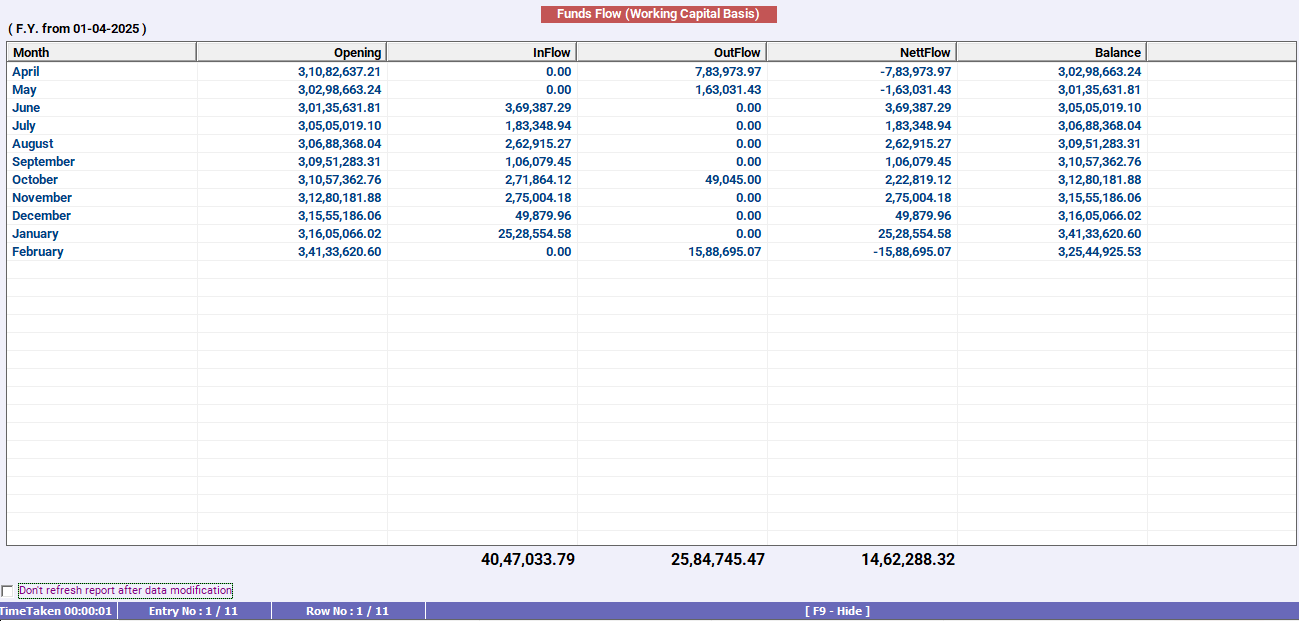
A fund flow statement is prepared for a period between two dates, such as between two year-ends or two month-ends. It focuses on the movement of funds rather than daily cash transactions. In simple terms, it shows how your financial position changed and what caused that change. Unlike cash flow, which tracks cash in and cash out, fund flow tries to explain how funds move across the balance sheet. That is why it is commonly linked with working capital changes and long-term funding decisions.
Download Free Fund Flow Statement Format in Excel. Customize it as per your requirement with zero cost.
Download the Fund Flow Statement Format in Excel
If you want a ready template that is easy to update, use the format of fund flow statement in Excel. It helps you compare two balance sheet dates, calculate the change in working capital, and create a final fund movement summary without manual totals. This Excel sheet gives you auto-totals so increases and decreases are calculated instantly, fully editable fields so you can match your own balance sheet headings, and a clean layout that makes sources and uses easy to compare at a glance.
What should be Included In the Fund Flow Statement format?
The first important part is the working capital comparison. This section includes current assets such as cash, bank, debtors, stock, and advances, and current liabilities such as creditors, outstanding expenses, taxes payable, and other short-term payables. The difference between current assets and current liabilities gives working capital for each date, and the change explains whether funds were blocked or released.
The second key part is funds from operations. Here, you start with profit and adjust non-cash items like depreciation and similar entries. This is important because net profit is not the same as funds generated from operations.
The final part is the fund flow statement itself, where you list sources and uses. Sources usually include capital introduced, long-term loans taken, sale of fixed assets, sale of investments, and funds from operations. Applications usually include the purchase of fixed assets, repayment of long-term loans, purchase of investments, and drawings or dividends if applicable. The change in working capital is also included in this statement, so both sides match.
How to Prepare a Fund Flow Statement Step by Step
A fund flow statement becomes easy when you follow the same order every time. Start by comparing two balance sheets, then calculate funds from operations, and finally explain the movement through sources and applications. If you keep this sequence, your totals match more easily, and the statement stays logical.
- Start with two balance sheets, one for the beginning date and one for the ending date.
- Fill in the current assets and current liabilities for both dates, then calculate the change in working capital.
- Review what changed the most in working capital, such as debtors or stock, increasing heavily.
- Calculate funds from operations using profit and loss figures.
- Add back depreciation and adjust other items that do not involve actual fund movement.
- Prepare the sources and application statement by listing major changes in long-term items.
- Include loan changes, capital introduced, fixed asset purchase or sale, and investment movement.
- Match total sources with total applications. If they do not match, recheck missing heads, working capital placement, or any long-term change not captured.
Common Mistakes To Avoid
Most fund flow mistakes happen because people mix it up with cash flow or place items in the wrong section. If you avoid the common errors below, your statement will look clean, and totals will match faster. A quick review of these points also helps when you are troubleshooting a mismatch.
- Treating fund flow like cash flow, even though fund flow is meant to explain the movement of funds between two dates, not daily cash receipts and payments.
- Mixing non-current items into the working capital section. Fixed assets and long-term loans should not be part of the working capital schedule.
- Taking net profit directly as funds from operations without adjusting non-cash items like depreciation.
- Missing the working capital increase or decrease in the final fund flow statement, which often causes totals not to match. If the totals do not match, recheck this first.
When Should You Prepare a Fund Flow Statement?
A fund flow statement is most useful for yearly review, bank discussions, or when you want to explain major changes in your balance sheet in a simple and logical way. It is also useful when your business shows profit but still struggles with liquidity, because it highlights how working capital and funding decisions affected your position.
If you want a clear picture of how funds were managed over a period, a fund flow statement does the job in a way that is easy to understand and easy to explain.