
Union Budget 2026: Key Highlights
Quick Summary
- The Union Budget 2026 focuses on economic growth, social welfare, and inclusive development through three main duties called Kartavyas.
- A ₹10,000 crore SME Growth Fund and additional support for micro enterprises aim to help MSMEs expand and access funding.
- New initiatives in biopharma, manufacturing, and textiles are set to boost India's global competitiveness and innovation.
- Infrastructure investments include high-speed rail corridors and new national waterways to support economic growth and urban development.
- Tax and customs reforms simplify processes, support domestic manufacturing, and encourage foreign investment and trade.
The Union Budget for the financial year 2026–27 was presented on February 1, 2026, in Parliament. This year’s Budget focuses on global economic uncertainty, realignment of the supply chain, and evolving investment dynamics, while reinforcing India’s commitment to sustained growth and fiscal discipline.
The finance minister, Nirmala Sitharaman, mentioned that the government aims to “transform aspiration into achievement and potential into performance.” She stated this year’s Budget as a Yuva Shakti–driven Budget, with proposals primarily focused on strengthening domestic manufacturing, scaling high-growth services, and backing infrastructure as key drivers of long-term economic expansion
The Three Duties (Kartavyas)
This year’s budget focuses on three main duties, also called Kartavyas.
- The first duty is to accelerate and sustain economic growth.
- The second duty is to meet citizens' aspirations and help households become stronger.
- The third duty is to ensure development includes all communities, regions, and sectors.
These three duties show that the government wants to balance economic growth with social welfare and development for everyone.
Book A Demo
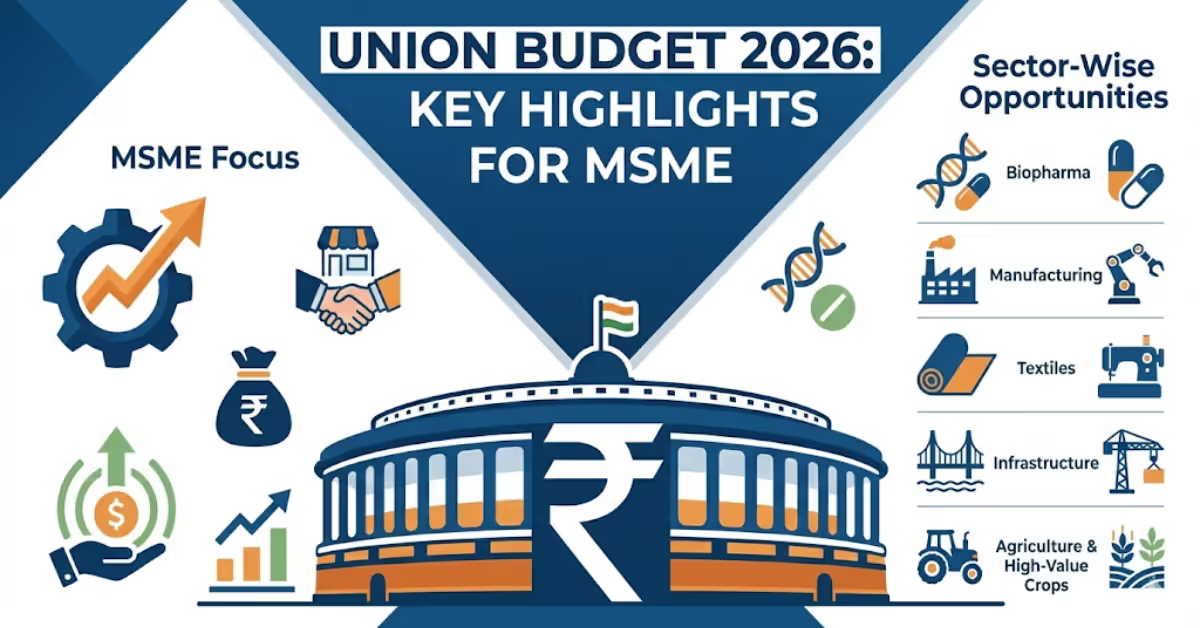
Union Budget 2026: Key Highlights for MSME
Here are some major highlights of the Union Budget for MSMEs
1. SME Growth Fund for Expansion-Stage MSMEs
The Budget introduces a ₹10,000 crore SME Growth Fund to support MSMEs ready to expand. Instead of traditional loans, this fund provides equity and risk capital, so businesses can grow without repaying right away.
2. Additional Support for Micro Enterprises
A ₹2,000 crore addition to the Self-Reliant India Fund will continue to support micro enterprises. This aims to help the smallest businesses, which often find it hard to get formal funding.
3. Faster Payments Through Mandatory TReDS Adoption
To address delayed payments, the Budget calls for greater use of TReDS, particularly for purchases by central public sector companies. This should help MSMEs supplying to large buyers achieve more predictable cash flow.
4. CGTMSE Backing for Receivable Financing
The Budget suggests using CGTMSE-backed guarantees for invoice discounting. This reduces lenders' risk and makes it easier for MSMEs to convert approved invoices into working capital.
5. Revival of Legacy MSME Clusters
A new scheme will revive 200 old industrial clusters. The goal is to improve infrastructure, expand access to technology, and provide shared facilities to enable MSMEs to lower costs and compete more effectively.
6. Affordable Compliance Support Through Corporate Mitras
Corporate Mitras will be trained professionals who will help MSMEs with accounting, legal, and compliance tasks , especially in smaller cities, to make compliance affordable for them.
Sector-Wise Opportunities in Union Budget 2026-27
Here is the breakdown of sector-wise opportunities presented in the budget 2026-2027
Biopharma
The government has launched the Biopharma Shakti initiative with a ₹10,000 crore outlay over five years. The aim is to position India as a global hub for pharmaceutical manufacturing and innovation.
1. Biopharma SHAKTI
(Strategy for Healthcare Advancement through Knowledge, Technology & Innovation)
Biopharma SHAKTI aims to make India a top global centre for biopharma manufacturing. The scheme will have a budget of ₹10,000 crore over the next five years. The plan focuses on building a strong base for making biologics and biosimilars in India.
It includes setting up three new National Institutes of Pharmaceutical Education and Research (NIPERs) and upgrading seven existing institutes. Over 1,000 approved clinical trial sites will be created to support India’s clinical research and development.
2. Institutional and Talent Capacity Development
Three new national institutes will be established, and seven current ones will be upgraded to improve advanced pharmaceutical education, research, and skill development.
Academic and research programs will be updated to meet industry needs and global standards.
3. Clinical Research and Regulatory Infrastructure
A network of 1,000 approved clinical drug trial sites will be created across India. Regulatory processes will be strengthened to speed up approvals and increase global acceptance of Indian-made biopharma products.
Manufacturing
The Budget aims to encourage long-term industrial investment in India through targeted programs, cluster development, and expanding capacity. Key steps to boost manufacturing in important sectors include:
India Semiconductor Mission (ISM) 2.0
This aims to grow India’s semiconductor industry in equipment, materials, design, and supply chain, with a larger budget of ₹40,000 crore.
Construction and Infrastructure Equipment (CIE)
A new scheme will support the production of advanced and high-value construction and infrastructure equipment in India.
Container Manufacturing
A special Container Manufacturing Scheme will launch with a ₹10,000 crore budget over five years to help India compete globally.
Electronics Components Manufacturing Scheme
The budget will increase to ₹40,000 crore to boost local value addition and make the most of growing investments.
Rare-Earth Corridors
The creation of rare-earth corridors in Kerala, Tamil Nadu, Odisha, and Andhra Pradesh to support the mining, processing, research, and manufacturing of strategic and critical minerals.
Revival of Legacy Industrial Clusters
A new scheme will help revive 200 old industrial clusters by upgrading infrastructure and technology to make them more competitive and efficient.
Textiles
The Union Budget 2026–27 highlights textiles as a key sector for jobs, exports, and regional industry. The Budget takes a broader approach to modernising traditional textiles, enhancing fibre self-reliance, and upgrading skills across the industry. Key steps for textiles include:
Integrated Textile Programme comprising five components:
1. The National Fibre Scheme will support self-reliance in natural, man-made, and new-age fibres.
2. The Textile Expansion and Employment Scheme will modernise traditional clusters by providing capital support for machinery and technology upgrades.
3. The National Handloom and Handicraft Programme will integrate and strengthen existing schemes for artisans and weavers.
4. The Tex-Eco Initiative will promote globally competitive and sustainable textiles and apparel.
5. Samarth 2.0 will modernize and upgrade the textile skilling ecosystem through industry and academic collaboration. These steps aim to boost productivity, add value, and help India compete better in global textile and apparel markets.
6. The Mahatma Gandhi Gram Swaraj Initiative has been announced to boost the khadi, handloom, and handicraft sectors. Under this initiative, the government will push these products globally and also provide branding and marketing support.
Infrastructure
The Union Budget continues to invest in public projects to improve logistics, urban growth, and industry, which also encourages private investment.
Key infrastructure-related initiatives include:
1. Public capital expenditure will be ₹12.2 lakh crore in FY27 to keep up momentum in building infrastructure.
2. Seven high-speed rail corridors will be developed to improve connections between cities and support economic growth in key regions.
3. Twenty new national waterways will be put into use to improve inland water transport, helping connect industrial clusters, mineral-rich areas, and ports. be ongoing work to improve infrastructure in Tier II and Tier III cities with over 5 lakh people, as these cities are becoming new growth centers.
4. City Economic Regions (CERs) will be developed, each receiving ₹5,000 crore over five years, to drive growth and strengthen urban economic clusters using a challenge-based, reform-focused funding model.
5. Regional development will focus on building infrastructure to support manufacturing, service hubs, and urban economic areas.
Agriculture & High-Value Crops
The Budget emphasises boosting farmer incomes through high-value crops such as coconut and cashew, especially in coastal regions. Measures will be taken to support the incomes of walnut, almond, and pine-nut farmers, and states will be supported in sandalwood cultivation to diversify farm incomes. The aim is to make India self-reliant in the production and trade of these crops.
Major Tax and Custom Reforms
1. Tax Reforms
A simplified and modernised Income Tax framework was introduced with redesigned rules to fasten the filing process and reduce compliance complexity. Foreign companies do not have to pay tax on income from cloud services delivered through data centres in India until 2047, though this tax break does not apply to other types of foreign businesses.
The reforms introduce measures to reduce litigation and improve trust-based tax administration, such as rationalising penalties, decriminalising minor offences, and integrating assessment and penalty proceedings.
Additionally, there is an extension and rationalisation of safe harbour provisions, particularly for Information Technology and IT-enabled services, to provide greater certainty on transfer pricing and tax outcomes.
Targeted tax measures support manufacturing, services, and export-oriented sectors, including incentives for data centres, cloud services, toll manufacturing, and bonded warehousing. Reforms also support foreign investment and global mobility, including exemptions and simplified tax treatment for non-resident experts and foreign service providers operating from India.
2. Customs reforms
These reforms aim to simplify the customs tariff structure, support domestic manufacturing, promote export competitiveness, and address duty inversion. Also, phased removal of long-standing customs duty exemptions on items manufactured domestically or where imports are negligible.
Expansion of duty-free and concessional duty provisions is introduced to support export-oriented sectors, including marine products, leather, textiles, electronics, and energy transition technologies.
Moreover, trust-based customs systems, including extended duty deferment periods and greater facilitation for authorised and compliant importers, are to enable faster clearance and lower transaction costs.
Measures to boost customs processes through automation and risk-based assessments, supporting smoother movement of goods across borders and supporting India’s trade facilitation framework.
