CGTMSE Guarantee Cover on TReDS: Faster Invoice Cash for Micro and Small Enterprises
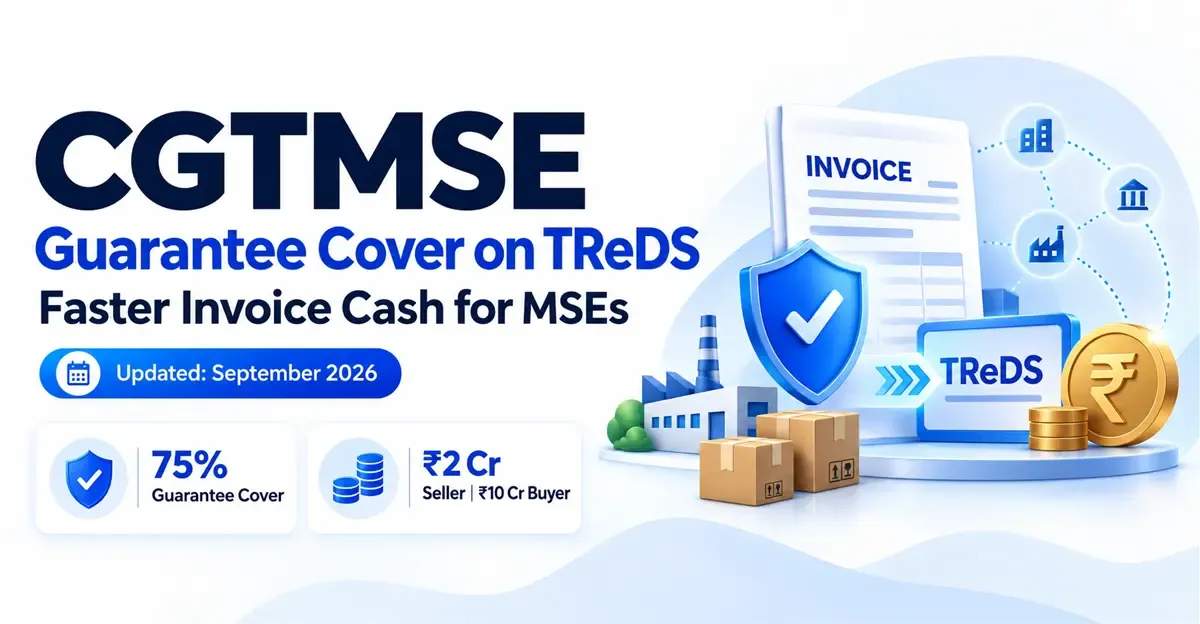
- CGTMSE covers 75% of the eligible amount in default on qualifying TReDS transactions between micro and small enterprises.
- Both the seller and buyer must be classified as micro or small enterprises to qualify for the special guarantee provision.
- Revolving exposure is capped at ₹2 crore per MSE seller and ₹10 crore per MSE buyer.
- The financing must be free from collateral security and third-party guarantees.
- A buyer with an overdue payment on any TReDS platform remains ineligible until the amount is cleared in full.
An accepted invoice confirms a sale, but the seller may still have to wait weeks or months for payment. The Trade Receivables Discounting System, or TReDS, allows eligible MSME sellers to obtain finance against accepted invoices through participating financiers.
The CGTMSE guarantee cover on TReDS provides credit-guarantee support for transactions in which both the seller and buyer are micro or small enterprises. The cover protects the financier against part of an eligible default. It does not guarantee approval for financing or a lower discount rate.
This guide is for micro and small business owners, finance teams, accountants and advisers assessing whether an invoice may qualify for CGTMSE-backed TReDS financing.
Get Your Invoices TReDS-Ready
Use BUSY to track receivables, reconcile balances and keep invoice records ready for financing.
- Invoice-Wise Outstanding
- Receivables Ageing
- Faster Reconciliation
Timeline for CGTMSE cover on TReDS
CGTMSE introduced the special TReDS provision through Circular No. 262/2026-27 , dated 15 June 2026. The circular sets out the eligibility requirements, exposure ceilings, guarantee fees, cover period and claim process.
On 23 June 2026, the Reserve Bank of India issued RBI/DPSS/2026-27/406 , the Reserve Bank of India (Trade Receivables Discounting System) Directions, 2026. These Directions allow eligible financiers to obtain cover for TReDS exposures from government-established credit-guarantee trusts.
On 23 September 2026, M1xchange announced that it had operationalised the mechanism and completed the first CGTMSE-backed transaction on its TReDS platform. Its system allows participating financiers to check eligibility, calculate the guarantee fee and apply for cover digitally.
TReDS Guarantee Cover Eligibility
Business and Transaction Requirements
Both the seller and buyer must be classified as micro or small enterprises under the M icro, Small and Medium Enterprises Development Act, 2006.
The special provision does not apply when the seller is an MSE but the buyer is a large company, government department or public sector undertaking. Such an invoice may still qualify for regular TReDS financing, but it will not receive this CGTMSE cover.
Medium enterprises are also outside the scope of the special provision. They may participate in regular TReDS transactions where they meet the applicable requirements.
The facility must be free from collateral security and third-party guarantees. The buyer must also have no overdue payment on any TReDS platform when the Factoring Unit is discounted. If an overdue exists, the buyer remains ineligible across platforms until the full amount is cleared.
Financier Requirements
Banks and NBFCs seeking the cover must be registered as Member Lending Institutions with CGTMSE and must participate on TReDS.
Other TReDS financiers may be considered individually if they meet the conditions set by CGTMSE.
How TReDS Invoice Discounting Works
A qualifying transaction generally follows these steps:
- Factoring Unit Creation: The seller or buyer creates a Factoring Unit containing the invoice or bill details.
- Counterparty Acceptance: The other party accepts the Factoring Unit, confirming the payment obligation.
- Financier Bidding: Participating financiers submit bids stating their discount rates and terms.
- Bid Selection: The seller or buyer selects a suitable bid, depending on whether the transaction uses factoring or reverse factoring.
- Guarantee Application: For an eligible transaction, the financier checks the available CGTMSE cover and submits the application through the TReDS platform.
- Seller Payment: The selected financier pays the seller after deducting the agreed discount and charges.
- Buyer Settlement: The buyer pays the financier on the invoice due date.
Both factoring and reverse factoring can qualify. CGTMSE does not provide the invoice finance directly and does not replace the buyer’s payment obligation.
TReDS Guarantee Fee and Exposure Limits
Revolving Exposure Limits
An MSE seller can receive covered financing of up to ₹2 crore on a revolving basis across all TReDS platforms.
An MSE buyer can have covered exposure of up to ₹10 crore. This limit includes exposure across TReDS platforms and guarantees issued against the buyer under other CGTMSE schemes.
These limits are not per invoice and do not represent assured financing. As financed invoices are settled, capacity may become available for new transactions. Every new Factoring Unit remains subject to acceptance, bidding and eligibility checks.
Guarantee Fee Slabs for Banks
| Guarantee Amount | Standard Annual Rate |
|---|---|
| Up to ₹10 lakh | 0.37% |
| Above ₹10 lakh to ₹50 lakh | 0.55% |
| Above ₹50 lakh to ₹1 crore | 0.60% |
| Above ₹1 crore to ₹2 crore | 0.85% |
| Above ₹2 crore to ₹5 crore | 1.00% |
| Above ₹5 crore to ₹8 crore | 1.10% |
| Above ₹8 crore to ₹10 crore | 1.20% |
Guarantee Amount
Standard Annual Rate
Guarantee Amount
Standard Annual Rate
Guarantee Amount
Standard Annual Rate
Guarantee Amount
Standard Annual Rate
Guarantee Amount
Standard Annual Rate
Guarantee Amount
Standard Annual Rate
Guarantee Amount
Standard Annual Rate
The applicable risk premium is added to the standard rate. Existing CGTMSE concessions based on factors such as borrower category, location or ZED certification may also apply.
NBFC Member Lending Institutions follow the fee framework under CGS-II instead of the bank fee schedule.
What the Guarantee Cover Does
The CGTMSE guarantee cover on TReDS protects the eligible financier against 75% of the amount in default. It does not cover 75% of every original invoice automatically.
For example, if the eligible amount in default is ₹8 lakh, the maximum guarantee portion before any claim adjustments would be ₹6 lakh.
(Note that this is only an illustration. The actual claim will depend on the scheme conditions and the amount approved by CGTMSE.)
The guarantee may encourage financiers to consider transactions involving smaller MSE buyers. However, it does not ensure more bids or lower financing costs. The final rate can depend on the buyer’s credit profile, invoice period, guarantee cost, competition among financiers and the financier’s risk policy.
Guarantee Period and Claim Window
The guarantee becomes effective when CGTMSE receives the applicable fee and remains valid until the Factoring Unit’s maturity date plus 91 days. If the account becomes a non-performing asset, a 60-day lock-in period applies.
The financier must claim the guarantee within 18 months after the lock-in period ends. Before making a claim, it must usually begin legal recovery action. Banks and NBFCs may be exempt from this requirement in certain cases under the applicable CGTMSE rules.
Preparing Your Records Before Using TReDS
Before presenting an invoice for financing, confirm that the Udyam classification, KYC information, bank details, invoice value, due date and buyer acceptance are accurate. The buyer’s overdue position and the available exposure of both parties should also be checked.
Your accounting records should separately capture the invoice amount, discount charges, funds received and final settlement. Accurate records do not establish eligibility on their own, but they can reduce mismatches during verification and reconciliation.
BUSY accounting software users can review customer balances through Outstanding Analysis and Ageing Receivables reports. This can help finance teams identify unpaid invoices, review ageing and reconcile balances before approaching a participating TReDS platform.
Conclusion
The CGTMSE guarantee cover on TReDS expands invoice-financing support for transactions where both the seller and buyer are micro or small enterprises. It can reduce part of the financier’s default risk, but it does not replace credit assessment, accurate invoicing or timely payment.
Before relying on the scheme, confirm the classification of both businesses, check the buyer’s overdue status, review the available exposure and compare the complete cost of each financing bid.
Businesses using BUSY can start by reviewing outstanding invoices and ageing reports so that their receivables records are ready for the TReDS process.