New GST on Batteries: Auto, Inverter, and More
- The battery GST rate depends on the type of battery, HSN classification, and applicable GST provisions. Many batteries, including automotive, inverter, and lithium-ion batteries, attract 18% GST.
- GST on battery products depends on their classification. Lead-acid batteries, lithium-ion batteries, and other battery categories are taxed as per their applicable HSN entries.
- Solar batteries do not automatically attract a lower GST rate. The applicable rate depends on the battery classification and whether it forms part of a qualifying solar power system.
- Earlier GST rates may differ based on the battery category and applicable provisions before rate revisions.
- Businesses can claim eligible Input Tax Credit (ITC) on batteries used for business purposes, subject to GST conditions.
Batteries are used in a wide range of applications — from cars and bikes to inverters and UPS systems. If you’re in the business of buying, selling, or using batteries, it’s important to understand how the Goods and Services Tax ( GST ) applies to them. In this blog, we’ll explain the battery HSN code and GST rate for different types of batteries used in homes, vehicles, and offices.
Serial Number Not Found? Track Battery Serial Wise
Join our guided walkthrough to see how BUSY can transform your business operations.
New GST Rate on Batteries in India
From 22 Sep 2025, batteries classified under HSN heading 8507 generally attract 18% GST. The applicable rate depends on the battery type and its classification under GST provisions. Earlier GST rates varied across battery categories, with some non-lithium battery types attracting higher rates.
GST Rate on Batteries in India
| Battery Type | New GST Rate (After 22 Sep 2025) | Old GST Rate (Before 22 Sep 2025) |
|---|---|---|
| Automotive battery, including lead-acid car and bike battery | 18% | 28% in many lead-acid battery classifications |
| Inverter battery, including lead-acid battery | 18% | 28% in many lead-acid battery classifications |
| UPS battery | 18% | 28% in many lead-acid battery classifications |
| Lithium-ion battery | 18% | 18% |
| Solar battery sold separately under heading 8507 | 18% | 28% or 18% depending on battery type and classification |
| Generic external rechargeable battery | 18% | 28% for certain non-lithium battery classifications |
Battery Type
New GST Rate (After 22 Sep 2025)
Old GST Rate (Before 22 Sep 2025)
Battery Type
New GST Rate (After 22 Sep 2025)
Old GST Rate (Before 22 Sep 2025)
Battery Type
New GST Rate (After 22 Sep 2025)
Old GST Rate (Before 22 Sep 2025)
Battery Type
New GST Rate (After 22 Sep 2025)
Old GST Rate (Before 22 Sep 2025)
Battery Type
New GST Rate (After 22 Sep 2025)
Old GST Rate (Before 22 Sep 2025)
Battery Type
New GST Rate (After 22 Sep 2025)
Old GST Rate (Before 22 Sep 2025)
Get a Free Trial – Best Accounting Software For Small Business
GST on Automotive Batteries
Under the revised GST structure from 22 Sep 2025, automotive batteries classified under HSN 8507 generally attract 18% GST. This includes common rechargeable batteries used in cars, bikes, trucks, and similar vehicles, subject to applicable classification.
GST on Inverter and UPS Batteries
Under the updated GST structure, batteries classified under HSN 8507 generally attract 18% GST. A separate point to remember is that an inverter or UPS unit may be classified differently from the battery itself. The battery component follows the applicable GST rate based on its classification.
Get a Free Trial – Best GST Accounting Software For Small Business
GST on Lithium-ion Batteries
Lithium-ion batteries continue to attract 18% GST under their applicable HSN classification. The rate revision mainly impacted certain other battery categories, which were aligned with the 18% GST rate under the revised structure.
Explore a Free Demo of – Best Inventory Management Software For Small Business
GST on Solar Batteries
A battery sold separately under HSN 8507 generally attracts 18% GST based on its classification. A solar project may involve separate GST treatment depending on the overall supply structure and applicable renewable energy provisions, but a standalone battery should not automatically be treated as a 5% solar goods entry.
Apply Correct GST Item Wise For Error Free Billing
* No credit card required
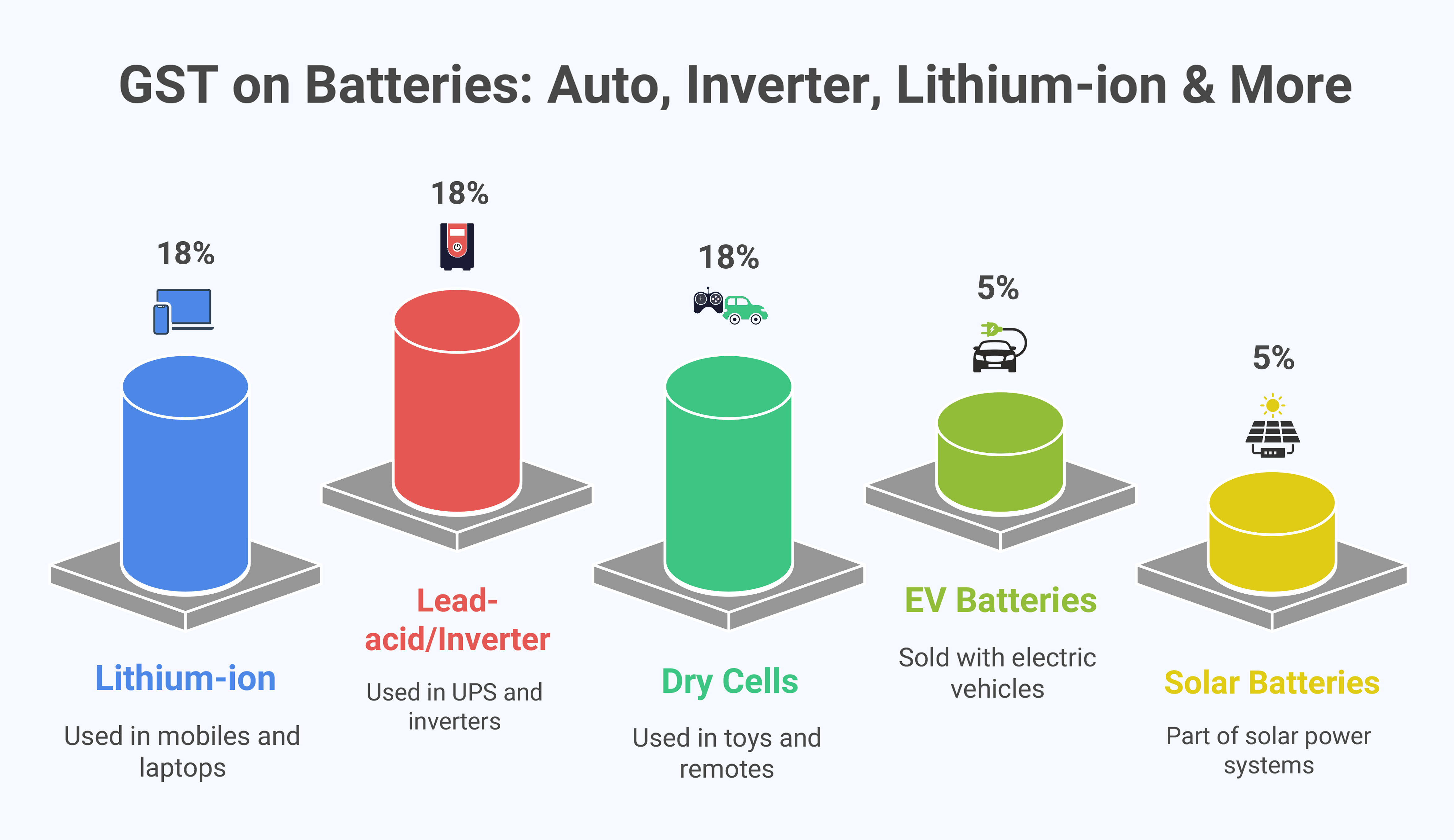
Summary Table: GST Rates for Battery Types
| Battery Type | Use Case | GST Rate |
|---|---|---|
| Lead-acid car battery | Automobiles | 18% |
| Lead-acid inverter battery | Home/office power backup | 18% |
| UPS battery | Computer/server backup | 18% |
| Lithium-ion battery | Smartphones, EVs, gadgets | 18% |
| Solar battery (sold separately under applicable battery classification) | Renewable energy use | 18% |
Battery Type
Use Case
GST Rate
Battery Type
Use Case
GST Rate
Battery Type
Use Case
GST Rate
Battery Type
Use Case
GST Rate
Battery Type
Use Case
GST Rate
Knowing the applicable GST rate for your battery helps businesses claim eligible Input Tax Credit (ITC) and manage GST compliance efficiently.
How to Calculate GST on Batteries
GST on batteries is calculated on the taxable value of the battery and the applicable GST rate. Under the current rate structure, batteries classified under HSN 8507 generally attract 18% GST.
GST Amount = Taxable Value × GST Rate
Final Invoice Value = Taxable Value + GST Amount
Example 1: Automotive battery
Suppose a car battery has a taxable value of Rs 10,000.
GST = 10,000 × 18% = Rs 1,800
Final Invoice Value = Rs 11,800
Example 2: Inverter battery
Suppose an inverter battery has a taxable value of Rs 15,000.
GST = 15,000 × 18% = Rs 2,700
Final Invoice Value = Rs 17,700
Example 3: Lithium-ion battery
Suppose a lithium-ion battery has a taxable value of Rs 20,000.
GST = 20,000 × 18% = Rs 3,600
Final Invoice Value = Rs 23,600
Input Tax Credit on Batteries
Businesses can claim eligible Input Tax Credit (ITC) on batteries used for business purposes, subject to applicable GST conditions, restrictions, and eligibility requirements.
Conclusion
The gst on battery depends on the battery type, HSN classification, and applicable GST provisions. Batteries such as automotive batteries, inverter batteries, UPS batteries, and lithium-ion batteries classified under the relevant headings generally attract 18% GST.
Solar batteries sold separately as batteries are also treated according to their battery classification. The GST rate should not be determined only because the battery is used in a solar application.
Knowing the correct GST rate helps businesses manage invoicing, compliance, and tax planning effectively.