What Is a Deposit Slip?
- A deposit slip, also called a pay-in slip, is a paper form used when depositing cash or a cheque at a bank branch.
- It usually captures your account number, account holder name, date, amount, denomination breakdown for cash deposits, and signature.
- PAN is generally required where cash deposits exceed ₹50,000 during any one day with a bank. If PAN is not available, Form 60 may be required in eligible cases.
- Banks are required to report certain high-value cash transactions through the Statement of Financial Transaction in Form 61A, including cash deposits aggregating to ₹10 lakh or more in one or more non-current accounts and ₹50 lakh or more in one or more current accounts in a financial year.
- Some banks now offer branch-assisted digital workflows, downloadable forms, or cash deposit machines, though availability varies by bank and branch.
- Write clearly, avoid overwriting, and keep your stamped customer copy until the transaction is correctly reflected in your account.
A deposit slip is a standard form provided by banks that you fill out when depositing cash or a cheque at a bank branch. It serves as a written record of the transaction for branch processing and gives the depositor an acknowledgement of what was submitted.
When you hand over the filled slip along with cash or a cheque, the bank usually keeps one copy of the original and stamps the customer portion before returning it to you. This stamped copy is an important record of submission and can help if there is a delay, a mismatch, or a dispute about the deposit.
Banks maintain records of deposit transactions for operational, audit, and compliance purposes. A deposit slip or stamped acknowledgement is one of the basic documents used to support that record-keeping.
In everyday banking, deposit slips are still widely used for branch-based cash deposits, cheque deposits, third-party deposits in permitted cases, and business cash handling. Even with digital banking becoming more common, this simple form continues to matter because it helps link the money or cheque being submitted to the correct account.
Record Deposits and Bank Entries Correctly in Accounts
Join our guided walkthrough to see how BUSY can transform your business operations.
Deposit Slip vs. Pay-In Slip - Are They the Same?
Yes, in India, "deposit slip" and "pay-in slip" are generally used interchangeably. Both refer to the form used to deposit money into a bank account at a branch. In common usage, they mean the same thing.
That said, the exact naming can vary by bank, branch, and form layout. Some banks may use the term "cash deposit slip," others may say "pay-in slip," and some may use labels like "cash/cheque deposit voucher." The difference is usually about terminology, not function.
| Term | Common Usage |
|---|---|
| Deposit Slip | Often used in private sector banking and general consumer language |
| Pay-In Slip | Common in public sector bank branches and traditional banking usage |
| Cash/Cheque Deposit Voucher | Used by some banks and institutions for specific branch formats |
Term
Common Usage
Term
Common Usage
Term
Common Usage
From a practical user’s point of view, both terms usually refer to the same type of branch deposit form.
Types of Deposit Slips in India
Not all deposit slips are identical. The type of form depends on what you are depositing and how the bank handles that transaction.
| Type | Used For | Notes |
|---|---|---|
| Cash Deposit Slip | Depositing currency notes at a branch | Usually includes a denomination breakdown |
| Cheque Deposit Slip | Depositing one or more cheques | Includes cheque details instead of note count |
| Third-Party Deposit Slip | Depositing into another person’s account, where permitted | Some banks may ask for extra depositor details |
| RTGS/NEFT Form | Requesting a branch-based fund transfer | Separate from a standard deposit slip |
| Tax Challan | Making statutory tax payments | Government-prescribed payment form, not a regular deposit slip |
Type
Used For
Notes
Type
Used For
Notes
Type
Used For
Notes
Type
Used For
Notes
Type
Used For
Notes
Cash Deposit Slip
This is the most common type. It is used when you physically deposit currency notes at the bank counter. It generally includes:
- date
- account number
- account holder name
- amount in figures and words
- denomination table
- signature
The denomination table is especially important because it tells the bank how the total cash amount is made up - for example, ₹500 notes, ₹200 notes, ₹100 notes, and so on.
Cheque Deposit Slip
This form is used when you are depositing a cheque into a bank account. Instead of a denomination section, it typically asks for:
- cheque number
- cheque date
- drawee bank name
- branch name
- amount
Some banks use the same slip for both cash and cheque deposits, while others have separate forms.
Third-Party Deposit Format
Where allowed, a person may deposit money into someone else’s account using a branch deposit slip. In such cases, the bank may ask for extra depositor details. However, this is not uniform across all banks. Some may ask for the depositor’s name and mobile number, some may ask for the relationship or purpose, and others may simply process the deposit based on account details and the amount involved.
RTGS/NEFT Forms
These are sometimes confused with deposit slips, but they are not the same thing. A branch RTGS or NEFT request form is meant to instruct the bank to transfer money electronically, not to deposit physical cash or a cheque into an account as a deposit slip does.
Tax Challans
A tax challan is also different. It is used for statutory or government payments , such as income tax or other prescribed payments. It should not be described as a standard deposit slip.
What is a Deposit Slip?
A deposit slip is a small form provided by banks that allows you to record the details of money deposited into an account. This can include cash, coins, or cheques. It acts as proof of the transaction and helps the bank process your deposit accurately.
When you fill out a deposit slip, you give the bank instructions on the amount to credit and the account to credit it to. You submit the completed form and the money or cheque to the bank teller or drop it in a deposit box.
Read More: Golden Rules of Accounting
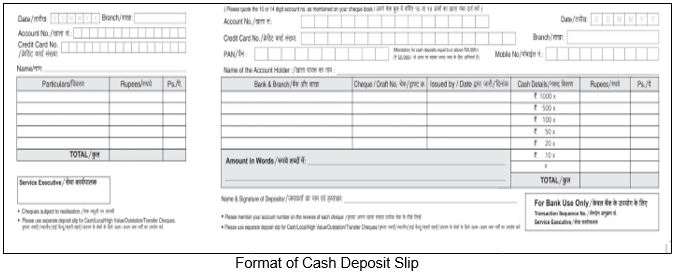
Front Side
The front of a deposit slip usually contains the core transaction details. While formats differ from bank to bank, most Indian deposit slips include the following fields:
| Field | What to Enter |
|---|---|
| Date | Current date, usually in DD/MM/YYYY format |
| Account Holder Name | Name as per bank records |
| Account Number | Full bank account number |
| Branch Name / Code | Branch details, if required |
| Mobile Number | Contact number if the form asks for it |
| Deposit Amount (Figures) | Amount in numeric form |
| Deposit Amount (Words) | Amount written in words |
| Denomination Table | Cash note breakdown |
| Cheque No. / Bank / Branch | Only for cheque deposits |
| PAN / Form 60 Details | If applicable for large cash deposits |
| Depositor’s Signature | Signature of the person making the deposit |
Field
What to Enter
Field
What to Enter
Field
What to Enter
Field
What to Enter
Field
What to Enter
Field
What to Enter
Field
What to Enter
Field
What to Enter
Field
What to Enter
Field
What to Enter
Field
What to Enter
Each field matters because the bank uses this information to identify the account, verify the amount, and process the transaction properly.
Back Side (Often Overlooked)
The back side of a deposit slip is often ignored, but in some cases it may contain:
- depositor details if different from the account holder
- declaration of correctness
- purpose of deposit
- branch instructions relating to cheque collection
- additional information for third-party deposits
Many people assume the reverse side is unimportant, but for business deposits, third-party deposits, or specific branch procedures, the bank may expect that section to be filled where relevant.
Some banks may require additional details on the reverse side for third-party deposits, business deposits, or special cases. Always read the printed instructions on the slip carefully.
How to Fill a Deposit Slip - Step-by-Step
Filling a Cash Deposit Slip
Filling a cash deposit slip correctly is simple, but small mistakes can create delays or even result in the bank refusing to accept the slip.
Step 1: Write the date
Enter the date in the format required on the form, usually DD/MM/YYYY.
Step 2: Enter the account number carefully
Write the full account number exactly as it appears in your passbook, cheque book, or banking app. One wrong digit can send the money to the wrong account or cause the deposit to be held.
Step 3: Write the account holder’s name
Use the name as per bank records. Writing clearly helps the teller verify the deposit quickly.
Step 4: Add your mobile number
If the slip asks for a mobile number, enter the correct one. This can help if the bank needs to contact you regarding the transaction.
Step 5: Fill the denomination table
Count the notes properly and mention the number of notes against each denomination.
Example:
₹500 × 10 = ₹5,000
₹100 × 5 = ₹500
Total = ₹5,500
Step 6: Write the total amount in figures
Enter the exact total in numeric form.
Step 7: Write the amount in words
Write the same amount in words to avoid mismatch.
Step 8: Provide PAN details where applicable
PAN is generally required when
cash deposits exceed ₹50,000
in a single day with a banking company or co-operative bank. If PAN is not available, Form 60 may be required in eligible cases.
Step 9: Sign the slip
Sign in the depositor’s signature field. If you are depositing into someone else’s account, you sign as the depositor.
Step 10: Submit the slip and cash
Hand over the filled slip and the cash to the teller.
Step 11: Collect the stamped customer copy
Keep this copy until the deposit is properly reflected in your bank account. It is an important acknowledgment of submission.
Avoid Mismatch Between Cash Book and Bank Records.
* No credit card required
Filling a Cheque Deposit Slip
Cheque deposit slips are slightly different because you are depositing an instrument rather than physical cash.
Step 1: Fill date, account number, and account holder name
These basic details should be entered clearly.
Step 2: Leave the denomination section blank
This section applies to cash, not cheques.
Step 3: Enter cheque details
Mention:
- cheque number
- cheque date
- issuing bank name
- branch name, if required
- cheque amount
Step 4: Write the amount in figures and words
If the form asks for both, make sure they match.
Step 5: Follow branch instructions on cheque endorsement
Some banks ask customers to write the account number and sign on the back of the cheque. However, this is not a universal rule in exactly the same format across all banks, so follow the printed branch or bank instruction.
Step 6: Sign the deposit slip
Do not forget this step.
Step 7: Submit the cheque and slip
Depending on the bank, you may hand it to the teller or place it in a cheque drop box.
Step 8: Keep the acknowledgment copy
Retain it until the cheque is realized and reflected correctly in your account.
Practical tip:
For outstation cheques or larger-value cheques, ask the bank about expected collection time and applicable charges before submitting them.
Bank-Specific Deposit Slip Guide
Different banks use slightly different deposit slip formats, but the core fields are usually similar. The main variation is in layout, whether separate slips are used for cash and cheques, and whether the bank offers downloadable forms or assisted branch workflows.
| Bank | Key Notes |
|---|---|
| SBI | Standard pay-in slip style commonly used at branches |
| HDFC Bank | Official forms available through forms section; branch practices may vary |
| ICICI Bank | May offer different branch or digital-assisted workflows depending on service type |
| Axis Bank | Standard deposit form with branch-specific processing instructions |
| Bank of India | Traditional branch pay-in slip format |
| PNB / Canara Bank / Bank of Baroda | Common public sector bank pay-in slip formats available at branch counters |
Bank
Key Notes
Bank
Key Notes
Bank
Key Notes
Bank
Key Notes
Bank
Key Notes
Bank
Key Notes
For the latest deposit slip format, always use the bank’s official website, official forms centre, or the form available at the branch itself. This helps ensure you are using the correct and current format.
Processing Timelines: How Long Does a Deposit Take?
Deposit timing depends on the type of deposit, the branch cut-off time, the bank’s internal process, and in cheque cases, the clearing arrangement.
| Deposit Type | Typical Processing Pattern |
|---|---|
| Cash at the home branch | Usually same day |
| Cash at a non-home branch | Usually same day, subject to bank process |
| Local cheque | Usually same day or next working day, subject to clearing policy |
| Outstation cheque | Depends on cheque collection policy and location |
| RTGS transfer | Real-time settlement, subject to system availability |
| NEFT transfer | 24x7x365, processed in regular settlement cycles |
Deposit Type
Typical Processing Pattern
Deposit Type
Typical Processing Pattern
Deposit Type
Typical Processing Pattern
Deposit Type
Typical Processing Pattern
Deposit Type
Typical Processing Pattern
Deposit Type
Typical Processing Pattern
Cash Deposits
Cash deposited at a bank branch is usually credited the same day, especially when submitted during working hours and before the branch's cut-off time. If the deposit is made near closing time or requires verification, the posting may take longer.
Local Cheques
Local cheques are generally credited on the same day or by the next working day, subject to clearing arrangements and the bank’s cheque collection policy.
Outstation Cheques
Outstation cheque collection depends on the bank’s cheque collection policy and the location involved. The actual time can vary by branch and clearing arrangement.
High-Value Cheques
Whether a cheque of ₹2 lakh or more is credited on the same day depends on clearing arrangements, the instrument, the bank’s process, and the branch cut-off time.
NEFT and RTGS
NEFT is available 24x7x365 and processed in regular settlement cycles. RTGS is also available 24x7x365 for eligible transactions. Actual credit timing may still vary slightly depending on the systems and the bank’s processing.
Practical Cut-Off Point
If you submit a cheque after the branch cut-off time, the bank may process it on the next working day, even if the broader clearing framework is fast.
PAN Rules, SFT Reporting & 2026 Income Tax Compliance
This is one of the most important sections how to fill out the form and ignore the tax reporting side.
PAN Requirement at the Branch
For cash deposits at a bank or co-operative bank, PAN is generally required when the amount exceeds ₹50,000 in a single day. If the depositor does not have a PAN, Form 60 may be required in eligible cases.
Users should be careful with large same-day cash deposits because the threshold applies to cash exceeding ₹50,000 in a single day.
Statement of Financial Transaction (SFT) - Form 61A
Under the income-tax reporting framework, banks are required to report certain specified transactions through Form 61A.
The key deposit-related thresholds commonly relevant here are:
| Account Type / Transaction Type | Reporting Threshold |
|---|---|
| One or more accounts other than the current account and time deposit | Cash deposits aggregating to ₹10 lakh or more in a financial year |
| One or more current accounts | Cash deposits or withdrawals aggregating to ₹50 lakh or more in a financial year |
Account Type / Transaction Type
Reporting Threshold
Account Type / Transaction Type
Reporting Threshold
The reporting framework is tied to the specified account category and aggregation rules.
Filing Deadline for Form 61A
The due date for furnishing the Statement of Financial Transaction is generally on or before 31 May immediately following the financial year in which the reportable transaction is recorded.
Penalties
Non-compliance with statement-filing requirements can result in consequences under the tax law.
2026 Income Tax Compliance Note
The Income-tax Rules, 2026 , were notified on March 20, 2026 and came into force on April 1, 2026. Always check the latest PAN quoting, Form 60, and reportable transaction rules applicable on the date of deposit, especially for large cash transactions.
Practical Takeaway
Even if a single deposit is not very large, aggregate annual cash deposits can still fall within reportable categories under SFT. That does not automatically mean there is any violation. It means the bank may be required to report the transaction category under the prescribed system.
Digital Deposit Slips: The Paperless Alternative
Many banks are gradually reducing their dependence on manual paperwork, but the exact process varies by institution.
In practice, paperless or semi-digital alternatives may include:
- downloadable deposit slip formats from official bank websites
- pre-filled branch forms
- token or kiosk-based assisted service at branches
- cash deposit machines for eligible transactions
- app-assisted or internet banking-assisted workflows for branch services
Some banks offer digital or assisted deposit workflows, but availability varies by bank, branch, account type, and transaction type.
Cash Deposit Machines
Cash deposit machines can reduce the need for manual paper slips for eligible deposits. The customer enters account details, feeds the cash into the machine, and gets a receipt.
Branch-Assisted Digital Workflows
Some banks may allow customers to download forms, pre-fill deposit details, or use assisted branch services. But not every transaction, especially third-party or special-case deposits, can be completed in a fully paperless way.
What Users Should Do
For branch deposit workflows, check your bank’s official website, check the official app, ask the branch, and avoid relying on random third-party form websites for critical banking transactions.
Common Mistakes to Avoid
| Mistake | Consequence | Better Practice |
|---|---|---|
| Wrong account number | Credit to the wrong account or a delay | Verify against passbook, cheque book, or app |
| Overwriting/cutting errors | Slip may be rejected | Use a fresh slip |
| Illegible handwriting | Manual processing issue or delay | Write clearly, preferably in block letters |
| Mismatched amount in figures and words | The deposit may be held or corrected manually | Double-check both fields |
| Missing signature | Slip may not be accepted | Sign before submission |
| Forgetting the denomination breakdown | Delay in cash handling | Fill the note-wise count properly |
| Wrong date | Processing discrepancy | Use the actual date of deposit |
| Missing PAN / Form 60 details where required | Compliance issue or possible refusal | Carry the required details for large cash deposits |
Mistake
Consequence
Better Practice
Mistake
Consequence
Better Practice
Mistake
Consequence
Better Practice
Mistake
Consequence
Better Practice
Mistake
Consequence
Better Practice
Mistake
Consequence
Better Practice
Mistake
Consequence
Better Practice
Mistake
Consequence
Better Practice
A deposit slip looks simple, but most branch-level issues happen because of careless writing, a mismatch in amount fields , or incomplete compliance details.
Manage Receipts, Bank Entries, and Accounting Together in BUSY.
* No credit card required
When to Use a Deposit Slip
Use a deposit slip whenever you:
- Deposit cash at a bank branch
- Deposit a cheque into your account
- Deposit money into another person’s account where the bank permits it
- Deposit business collections at the branch
- Need a physical branch acknowledgment of submission
You generally do not need a manual deposit slip for:
- UPI transfers
- mobile banking deposits or transfers
- internet banking transactions
- ATM or cash deposit machine deposits where the machine generates its own receipt
- NEFT or RTGS transactions done online
Benefits of a Deposit Slip
A deposit slip serves several practical purposes:
1. Account Identification
It helps ensure the funds or cheque are linked to the correct account.
2. Transaction Acknowledgement
A stamped customer copy provides an acknowledgement that the cash or cheque was submitted at the branch.
3. Error Reduction
The structured format reduces the likelihood of account number errors, amount mismatches, and incomplete submission details.
4. Reconciliation Support
For businesses and professionals, deposit slips help reconcile branch deposits against bank statements and internal cash records.
5. Audit and Internal Control Use
Businesses handling frequent cash deposits often rely on deposit slips as part of their cash-control documentation .
6. Denomination Tracking
For cash deposits, the denomination table creates a record of how the total amount was tendered.
A stamped customer copy is an important acknowledgement and supporting record of the deposit submission.
How Long Should You Keep Deposit Slips?
| Category | Practical Retention Guidance |
|---|---|
| Personal deposits | Keep until fully reflected and reconciled in your bank statement |
| Business deposits | Retain as part of books, audit support, and internal records |
| Large-value deposits | Keep longer in case of scrutiny or dispute |
| Property or litigation-related deposits | Retain until the matter is fully settled |
Category
Practical Retention Guidance
Category
Practical Retention Guidance
Category
Practical Retention Guidance
Category
Practical Retention Guidance
Keep deposit slips until the transaction is fully reflected and reconciled in your bank statement. For business deposits, high-value transactions, or dispute-related matters, it is sensible to retain them for several years along with your accounting records . It is also wise to scan or photograph important slips because paper receipts can fade over time.
Conclusion
A deposit slip is an important transaction document that helps the bank process your cash or cheque deposit correctly and gives you an acknowledgment of what was submitted.
Write the correct account number, make sure the amount matches in figures and words, sign the slip, and keep the stamped customer copy until the transaction is correctly reflected in your account.
For larger cash deposits, PAN requirements and reportable transaction rules can apply depending on the amount and the annual aggregate pattern of deposits.
As banking becomes more digital , some branch deposit processes are becoming less paper-heavy, but physical deposit slips still remain relevant for cash deposits, cheque deposits, business banking, and certain third-party transactions. Knowing how to fill the slip correctly, when it is needed, and what the compliance implications are can help users avoid errors, delays, and unnecessary complications.