₹20 Lakh Collateral-Free MSME Loan: Eligibility, Documents and How to Apply
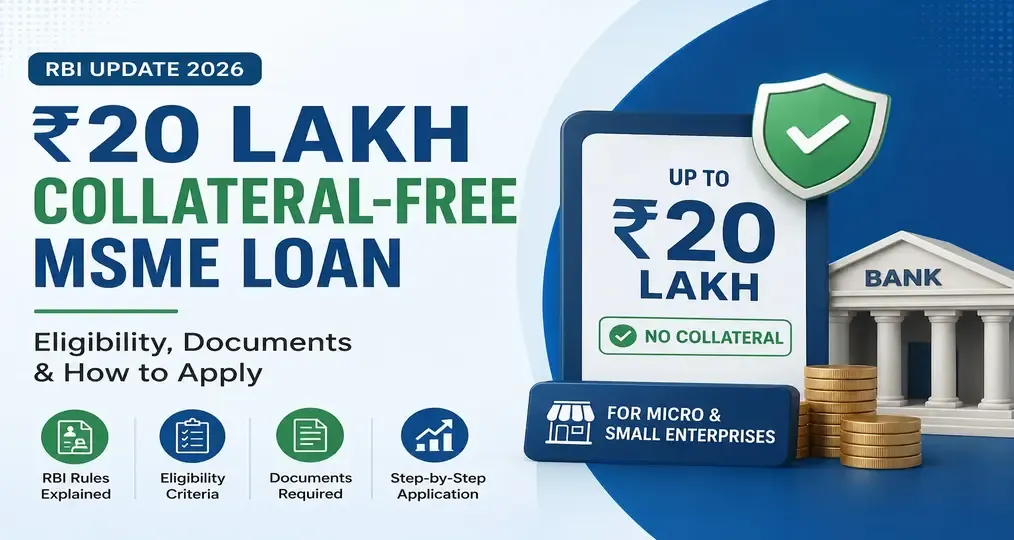
- From 1 April 2026, banks covered by the RBI’s MSME lending directions must not accept collateral security for loans of up to ₹20 lakh extended to micro and small enterprises.
- The rule only removes the collateral requirement. It does not guarantee approval or require the bank to sanction the full amount.
- Banks may use GST returns, bank transactions, credit history, and financial statements to assess repayment capacity.
- Udyam registration helps establish MSE status and is required when a lender applies for CGTMSE guarantee cover.
A collateral-free MSME loan can help a small business obtain working capital or expansion finance without pledging unrelated property. The funds may be used to purchase inventory, upgrade equipment, manage cash-flow gaps or expand business operations. However, approval still depends on the lender’s eligibility criteria, financial assessment and repayment capacity.
This guide is for Indian micro and small business owners, accountants and tax professionals preparing a loan application, especially GST-registered traders, manufacturers and service providers.
Keep Your Business Records Loan-Ready
With BUSY, keep GST, receivables, banking and financial records organised for faster and easier lender review.
What the RBI’s ₹20 lakh collateral-free rule means
The Reserve Bank of India issued the Lending to Micro, Small & Medium Enterprises Sector Amendment Directions, 2026 on 9 February 2026. For MSE loans sanctioned or renewed from 1 April 2026, covered banks must not accept collateral security up to ₹20 lakh. This went up from the earlier mandatory limit of ₹10 lakh.
A bank may also waive collateral for loans up to ₹25 lakh when the business has a good track record and sound financial position, subject to its internal policy. This higher limit is discretionary.
Note that the ₹20 lakh figure is a security threshold, not a guaranteed sanction. The bank can approve a lower amount or reject the application after assessing repayment capacity and business viability.
Collateral should also not be confused with primary security. Collateral generally means an outside asset, such as the owner’s house or unrelated property. Primary security may include stock, receivables or machinery financed through the loan. A collateral-free facility may therefore still contain primary-security or personal-guarantee conditions. CGTMSE also confirms that primary security is mandatory when a facility is covered under its CGS-I guarantee scheme.
Who is eligible for a ₹20 lakh collateral-free MSME loan?
The RBI provision applies to micro and small enterprises, not every business within the wider MSME category. Under the current classification effective from 1 April 2025:
| Enterprise Category | Investment Limit | Turnover Limit |
|---|---|---|
| Micro enterprise | Up to ₹2.5 crore | Up to ₹10 crore |
| Small enterprise | Up to ₹25 crore | Up to ₹100 crore |
Enterprise Category
Investment Limit
Turnover Limit
Enterprise Category
Investment Limit
Turnover Limit
The enterprise must remain within both limits for its category. The latest classification is available on the official Udyam portal.
Meeting the micro or small enterprise classification makes the business eligible for the RBI’s collateral-related protection, subject to the applicable loan conditions.
Is Udyam registration required?
Yes. Under the RBI’s MSME lending framework, enterprises are required to register on the Udyam portal, and banks use the classification recorded in the Udyam Registration Certificate to establish MSME status. Registration is free, paperless, and does not require renewal.
A Udyam Registration Number is also mandatory when a lender submits a new application for CGTMSE guarantee coverage. CGTMSE does not lend directly to businesses. The lender appraises and sanctions the facility before deciding whether to seek guarantee cover.
What banks check before approving an MSME loan
Removing collateral does not remove credit appraisal. Banks may examine turnover and profitability, bank-account conduct, existing EMIs, repayment history, customer receivables, business vintage and the proposed use of funds. A term loan may also require quotations, a project report and evidence of the owner’s contribution.
There is no RBI rule fixing one credit score or turnover level for a ₹20 lakh sanction. Each lender applies its own policy. A bank may reject an application for a collateral-free loan of up to ₹20 lakh if cash flow is insufficient, existing debt is high, records are incomplete or financial figures cannot be explained.
The lender should not, however, replace an unsuccessful credit assessment with a collateral demand that conflicts with the applicable RBI direction. Loan rejection and collateral requirements are separate issues.
Documents required for a ₹20 lakh MSME loan
There is no single RBI document list that applies to every lender. Requirements depend on the business structure, loan purpose, lending scheme and operating history.
| Document Category | Commonly Requested Records |
|---|---|
| Identity and business proof | PAN, accepted KYC, address proof, constitution documents and applicable licences. |
| MSME and tax records | Udyam certificate, GST registration and filed GST returns. |
| Financial records | Bank statements, income-tax returns, profit and loss account, balance sheet and existing loan details. |
| Loan-purpose records | Machinery quotations, stock requirement, project report or cash-flow projection. |
| Working-capital support | Receivables ageing, payables ageing and major customer or supplier information. |
Document Category
Commonly Requested Records
Document Category
Commonly Requested Records
Document Category
Commonly Requested Records
Document Category
Commonly Requested Records
Document Category
Commonly Requested Records
The period requested for GST returns, bank statements and income-tax returns varies by lender. New enterprises may be assessed more heavily on project viability, promoter experience, expected cash flow and margin contribution because they have limited operating history.
How banks use GST data for MSME loan approval
GSTR-1 records outward-supply details, while GSTR-3B provides a self-declared summary of turnover and tax liability. Banks may compare these returns with accounting records and bank collections to understand sales consistency and how quickly reported sales turn into cash.
Through the Account Aggregator framework, GSTN can share specified data with an authorised financial institution after the taxpayer gives consent. Completed GSTR-1 Table 4 data, GSTR-3B returns, filing details and basic profile information can be made available for up to 18 months.
GST data is not used alone. SIDBI’s GST Sahay model, for example, combines GST information with bank data obtained through Account Aggregator and credit-bureau information for invoice-based finance.
Consider a wholesaler that reports sales of ₹18 lakh in GSTR-1 but receives only ₹10 lakh in its bank account during the same month because some customers bought on credit. This is not automatically an error. Invoices, receivables ageing and later bank receipts should show a traceable movement from sale to collection.
How to apply for a ₹20 lakh MSME loan
Step 1: Confirm your MSE status
Check whether your business falls within the micro or small enterprise category and ensure that your Udyam registration details are current.
Step 2: Define the loan requirement
Decide how much funding you need and what it will be used for, such as working capital, stock purchases, machinery, or business expansion. Estimate whether the expected cash flow can support the repayment amount.
Step 3: Compare MSME loan options
Review suitable MSME bank loan products offered by different banks and financial institutions. The RBI collateral rule is not a separate loan scheme, while CGTMSE is a guarantee mechanism used by eligible lenders rather than a direct loan portal.
MUDRA is also a separate programme. Its Tarun Plus category covers loans above ₹10 lakh and up to ₹20 lakh, but only for entrepreneurs who previously took and successfully repaid a Tarun-category loan.
Step 4: Reconcile your financial records
Before applying, match your books with GSTR-1, GSTR-3B, receivables and bank entries. Keep explanations ready for actual timing differences caused by credit sales, returns, advance receipts or delayed customer payments.
Step 5: Submit the application
Submit the documents requested by the lender through its branch or official digital channel. Where Account Aggregator sharing is available, review the purpose, data range and consent period before allowing access.
Step 6: Review the sanction terms
Review the interest rate, processing and guarantee-related charges, repayment period, instalment amount, margin requirement, primary-security clause, personal guarantees and prepayment conditions.
How to improve your MSME loan eligibility
A strong application explains how much money is needed, where it will be used, and how the business will repay it. Keep Udyam and tax records current, disclose existing debt accurately, and correct genuine accounting errors before applying.
Ensure that the figures reported across your books, GST returns and bank records are current, traceable and supported by clear explanations where differences exist.
Avoid applying for the maximum amount merely because the collateral-free limit is ₹20 lakh. Request an amount supported by the business’s working-capital cycle, margins and expected collections.
What to do if a bank demands collateral
First ask whether the requested asset is collateral or primary security connected with the financed activity. Confirm that the applicant is a micro or small enterprise, the facility is within ₹20 lakh, and it is being sanctioned or renewed on or after 1 April 2026.
If the branch still requires outside collateral, request the reason in writing and refer to RBI/2025-26/206, dated 9 February 2026. Use the bank’s grievance process if the explanation does not address the rule.
RBI Complaint Management System may be used after following the bank’s complaint process where there is an eligible service or regulatory deficiency. However, the RBI Ombudsman does not act as an appeal forum against a bank’s commercial decision to approve or reject a loan.
Prepare loan-ready records with BUSY
BUSY accounting software helps businesses keep invoicing, GST records, accounting, receivables, bank reconciliation and financial reports in one connected system. Updated ledgers, reconciled transactions and readily available financial reports can make it easier to prepare records and respond to questions during a lender’s review.
Conclusion
The RBI’s revised collateral rule can improve access to finance for eligible micro and small enterprises, but the application must still meet the lender’s credit requirements. Before applying, confirm your MSE status, define the funding requirement clearly and ensure that your GST, banking and accounting records can support the amount requested.