Export Promotion Mission: Revised Airfare, Testing and Freight Support for MSMEs
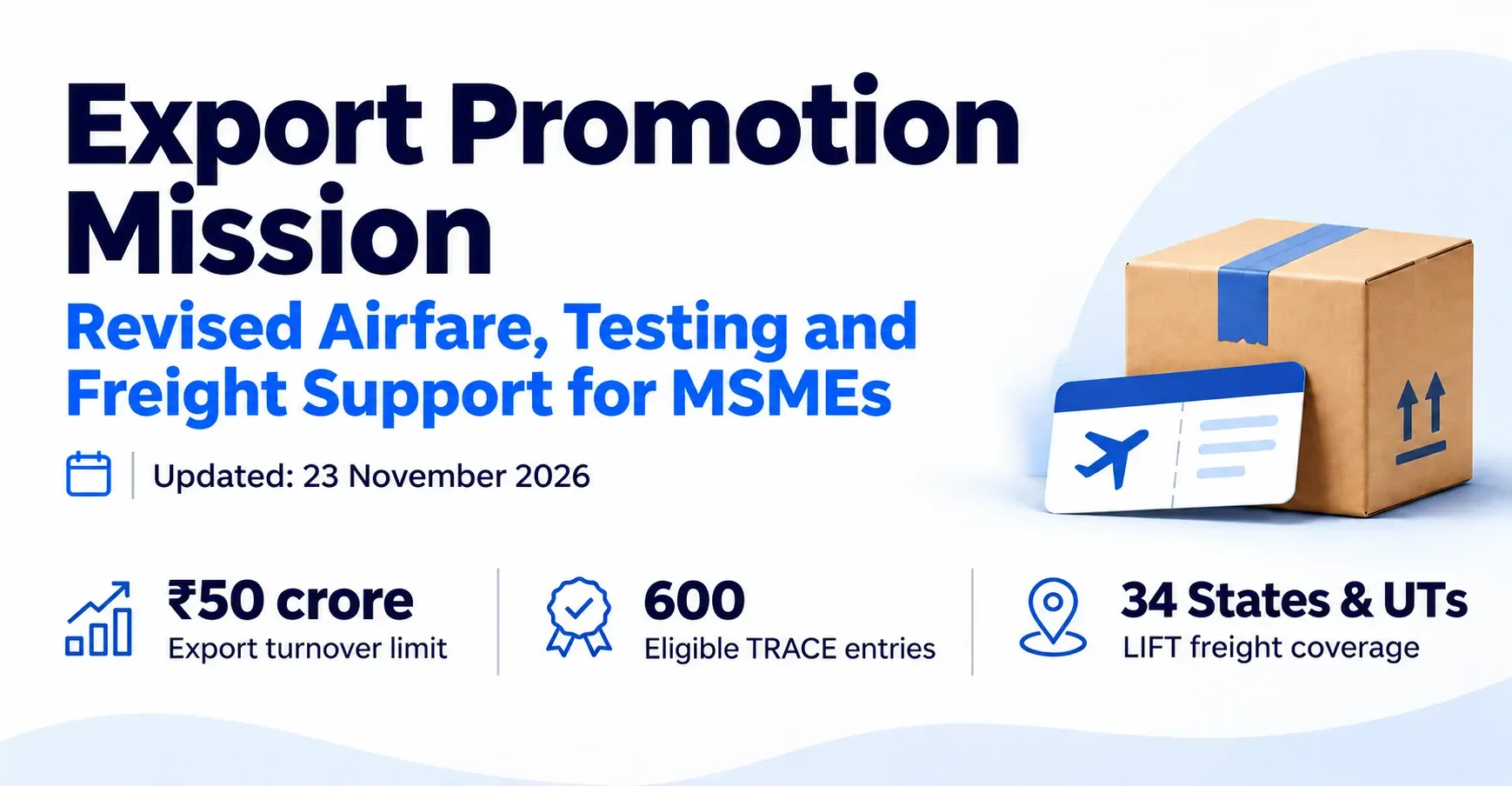
- The export turnover limit for airfare support has increased from ₹75 lakh to ₹50 crore.
- Eligible micro and small enterprises can receive up to 95% of economy-class airfare, while other eligible enterprises can receive up to 80%.
- The number of eligible testing, inspection and certification entries has increased from 462 to 600.
- Freight assistance now covers eligible districts across 34 States and Union Territories, up from 13.
- The revised rules apply from 17 November 2026.
On 17 November 2026, the Directorate General of Foreign Trade widened airfare, certification and inland freight support under the Export Promotion Mission. The revised rules make the scheme available to more exporters. However, businesses must still meet the relevant eligibility and claim requirements.
This guide is for Indian exporters, particularly micro, small and medium enterprises (MSMEs). It covers the revised airfare, certification and freight benefits, their eligibility conditions and claim limits.
Manage Your Export Business Smarter with BUSY
Keep your export transactions organised and gain better control over business costs.
- GST Invoicing
- Multi-Currency Accounting
- Expense & Payment Tracking
What Changed Under the Export Promotion Mission?
The Union Cabinet approved a ₹25,060 crore outlay for the Mission for FY 2025-26 to FY 2030-31. Niryat Protsahan supports access to trade finance. Niryat Disha supports market access and helps exporters meet overseas requirements. The November amendments affect airfare, certification and freight assistance under Niryat Disha.
Airfare Support: Eligibility and Reimbursement Limits
DGFT Trade Notice 35/2026-27 expands airfare assistance under Market Access Support (MAS) for exporters attending eligible trade fairs, buyer-seller meetings and trade delegations. Under the revised rules:
- Previous-year export turnover must not exceed ₹50 crore.
- The eligible delegate must be an Indian national travelling in economy class.
- New Importer-Exporter Code (IEC) holders must be registered with the relevant agency for at least three months.
- Where the membership requirement applies, businesses must be members of the organising agency for at least three months before the event.
An IEC is an identification code issued by DGFT for import and export activities.
Airfare reimbursement ceilings
Eligible micro and small enterprises can claim up to 95% of airfare, while other eligible enterprises can claim up to 80%. The amount cannot exceed the applicable destination limit.
| Previous Year's Export Turnover | Africa, Americas and Oceania | Other Overseas Markets |
|---|---|---|
| No exports | ₹80,000 | ₹45,000 |
| Above zero and up to ₹50 crore | ₹1,25,000 | ₹75,000 |
Previous Year's Export Turnover
Africa, Americas and Oceania
Other Overseas Markets
Previous Year's Export Turnover
Africa, Americas and Oceania
Other Overseas Markets
Example: A small enterprise with preceding-year export turnover of ₹6 crore spends ₹1,40,000 on an economy-class ticket for an eligible event in Africa. Although 95% of the airfare is ₹1,33,000, the business can claim a maximum of ₹1,25,000.
How To Apply for Airfare Assistance
- Confirm your eligibility with the event organiser or Export Promotion Council.
- Submit an online request expressing interest in financial support for the event.
- Check the claim process, required documents and submission deadline before booking tickets.
TRACE: Financial Support for Export Testing and Certification
Trade Regulations, Accreditation and Compliance Enablement (TRACE) helps MSMEs meet overseas product requirements by covering part of the certification and compliance costs. Trade Notice 37/2026-27 has expanded the scope of financial support from 462 to 600 eligible testing, inspection and certification entries. Some examples are listed below:
| Certification or Requirement | Applicable Products or Industry |
|---|---|
| Safe Quality Food (SQF) | Agricultural and food products |
| Roundtable on Sustainable Palm Oil (RSPO) | Food and industrial products |
| ISO 26262 | Safety of electrical and electronic systems in vehicles |
| Thailand Food and Drug Administration (FDA) | Food, cosmetics and medical devices |
| Saudi Food and Drug Authority | Food, medicines, medical devices and cosmetics |
Certification or Requirement
Applicable Products or Industry
Certification or Requirement
Applicable Products or Industry
Certification or Requirement
Applicable Products or Industry
Certification or Requirement
Applicable Products or Industry
Certification or Requirement
Applicable Products or Industry
Before paying for certification, check whether the requirement is listed for your product and export market.
TRACE Reimbursement Rates and Limits
The reimbursement rates under Trade Notice 09/2026-27 are:
| Business Category | Maximum Reimbursement |
|---|---|
| Micro and small enterprises | 95% of eligible costs |
| Medium enterprises | 80% of eligible costs |
Business Category
Maximum Reimbursement
Business Category
Maximum Reimbursement
Taxes, duties and cess are excluded from reimbursement calculations. The financial limits set by DGFT also apply. The annual reimbursement limit is ₹50 lakh per IEC. Requests for higher amounts can be considered individually after a detailed review.
TRACE applicants need an active IEC and valid Udyam registration and must not appear on DGFT’s Denied Entity List, which identifies entities restricted from specified trade benefits.
How To Claim TRACE Support
Businesses must submit an online Intent-to-Claim before obtaining the required certification or test report. This informs DGFT that the business plans to claim financial support. Approved support is paid in two installments to the bank account linked to the applicant’s IEC.
| Instalment | Payment Condition |
|---|---|
| First 50% | After successful certification and submission of supporting documents |
| Remaining 50% | After providing evidence of related exports and receipt of export payments |
Instalment
Payment Condition
Instalment
Payment Condition
LIFT: Revised Freight Support for MSME Exporters
Logistics Interventions for Freight and Transport (LIFT) helps MSMEs in eligible districts reduce the cost of transporting goods for export. LIFT applicants must hold an active IEC and valid Udyam registration and must not appear on DGFT’s Denied Entity List. Trade Notice 36/2026-27 introduces the following changes:
- All exportable goods from eligible MSMEs qualify, except those on the official exclusion list.
- The minimum eligible transport distance has decreased from 200 km to 100 km.
- Inland freight reimbursement is limited to 400 km, including journeys involving multiple stages or modes of transport.
- Inland waterways are now eligible alongside road and rail transport.
- Eligible destinations now include Land Customs Stations and Integrated Check Posts that have an attached Container Freight Station.
- Air freight support now extends to Jammu and Kashmir and Ladakh, in addition to the North-East.
The revised rules apply to shipments leaving MSME premises on or after 17 November 2026. Earlier shipments remain covered by Trade Notice 29/2025-26.
LIFT Reimbursement Rates and Limits
Under the existing LIFT guidelines, eligible MSMEs can receive up to 30% of eligible freight expenses, excluding applicable taxes. The maximum reimbursement is ₹20 lakh per IEC in a financial year.
For reimbursement calculations, eligible freight expenses are capped at 20% of the Free on Board (FOB) value of the goods. FOB value represents the export value of goods up to the point of loading for shipment. Any lower freight cost limit notified by DGFT also applies. These financial limits remain unchanged under the November amendments.
States and Districts Covered Under LIFT
| Coverage | Eligible Areas |
|---|---|
| All districts in 13 states and Union Territories | Assam, Arunachal Pradesh, Himachal Pradesh, Jammu and Kashmir, Ladakh, Manipur, Meghalaya, Mizoram, Nagaland, Sikkim, Tripura, Uttarakhand and Bihar |
| 308 selected districts across 21 additional states and Union Territories | Districts specified in Annexure I of Trade Notice 36/2026-27 |
Coverage
Eligible Areas
Coverage
Eligible Areas
Check whether your shipment's originating district appears in the official list before applying.
Which Exports Are Not Eligible for LIFT?
| Category | Excluded Products or Exports |
|---|---|
| Re-exports | Imported goods that are exported again |
| Deemed exports | Specified supplies treated as exports even though the goods do not leave India |
| Third-party exports | Goods exported by one exporter on behalf of another |
| Specified business units | Exports by or supplies to Special Economic Zones (SEZs), Export Oriented Units and other specified units. Restrictions also apply to goods manufactured by these units and exported through domestic businesses |
| Agricultural products | Wheat and specified categories of sugar, except jaggery |
| Rice | Excluded except for eligible units in the North-Eastern states, Uttarakhand and Jammu and Kashmir |
| Minerals and industrial products | Ores, slag, ash and ferro-alloys |
| Meat products | Specified frozen bovine meat |
Category
Excluded Products or Exports
Category
Excluded Products or Exports
Category
Excluded Products or Exports
Category
Excluded Products or Exports
Category
Excluded Products or Exports
Category
Excluded Products or Exports
Category
Excluded Products or Exports
Category
Excluded Products or Exports
Refer to Annexure II of Trade Notice 36/2026-27 for the complete exclusion list and product classification codes.
How To Apply for LIFT Support
Submit an online Intent-to-Claim before arranging transportation. Once the export is complete, link your reimbursement application to the original Intent-to-Claim. Exporters must submit the following documents when applying for freight reimbursement under LIFT:
- Transport invoice and proof of payment
- Shipping bill, which records customs details of the shipment
- E-way bill for the movement of goods
- Accepted bill of export for shipments through land borders
- Declaration confirming that no other financial assistance has been claimed or will be claimed for the same expense
Reimbursement is credited to the bank account linked to the IEC, subject to application approval and available funds.
Conclusion
The revised Export Promotion Mission rules make government export assistance available to a much wider group of businesses. For eligible MSMEs, this could reduce some of the costs involved in reaching overseas markets and meeting export requirements. However, reimbursement is not automatic and remains subject to the conditions and limits of each scheme. Exporters should review the relevant DGFT notice and confirm their eligibility before incurring costs.