New GST Rules 2026: Changes for Small and Online Sellers From 1 November
- Rule 14B simplifies GST registration for eligible online sellers using an e-commerce warehouse in another state.
- The ₹2.5 lakh monthly limit is based on GST liability on specified sales to registered businesses, not total sales.
- GST registration, cancellation and composition scheme procedures have been updated.
- New discount rules make it easier for businesses to adjust GST on discounts given after a sale.
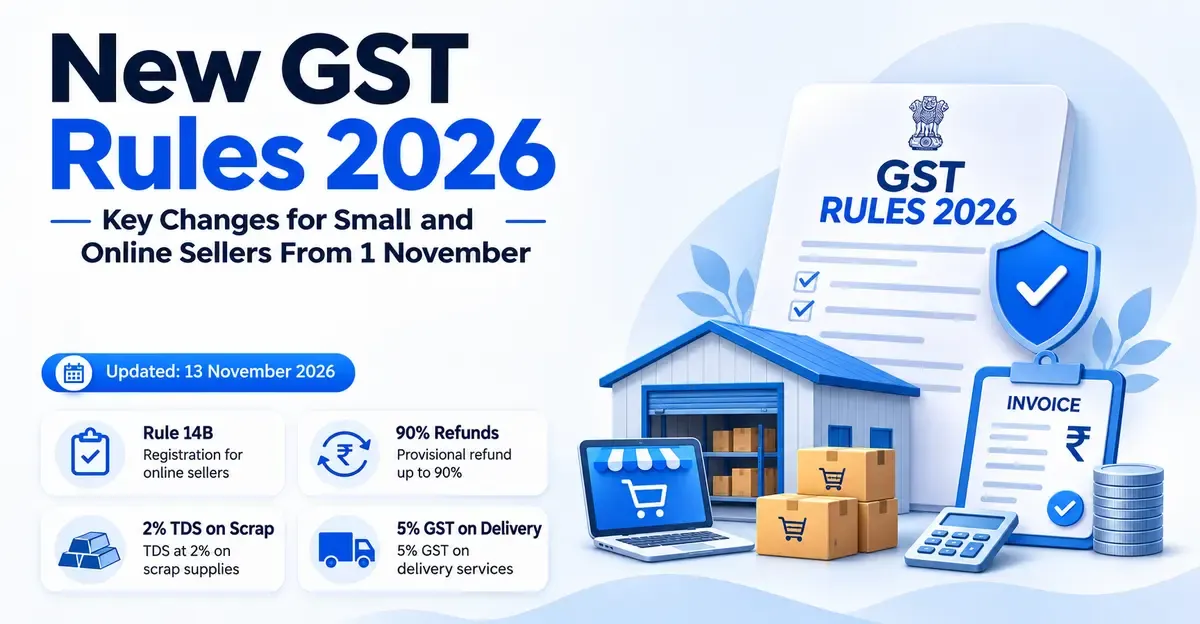
- Other changes include 90% provisional refunds, 2% TDS on specified scrap purchases and 5% GST on qualifying delivery services.
The new GST rules from 1 November 2026 introduce changes that affect how small businesses manage GST compliance. Understanding which rules apply is important, as following outdated procedures can lead to filing errors, incorrect tax reporting or delays.
This guide explains the main Central GST changes for small businesses, online sellers and finance teams. It covers the new requirements and their practical impact, but not product-specific GST rates, state-specific rules or advice for individual transactions.
Stay Ahead of GST Changes with BUSY
Stay prepared for changing GST requirements and keep your business compliant with less manual effort.
- GST Return Filing
- ITC Reconciliation
- GST Invoicing & Credit Notes
Rule 14B GST Registration for Online Sellers
Rule 14B provides simplified GST registration for e-commerce sellers who want to store and sell goods from another state without setting up their own office there.
An electronic commerce operator (ECO) is an online platform that facilitates sales. Under Section 52, the operator collects Tax Collected at Source (TCS) on applicable sales and deposits it with the government.
An eligible seller can declare an e-commerce warehouse as its principal place of business (PPoB). This is the main business address recorded in the GST registration. The seller still needs a separate Goods and Services Tax Identification Number (GSTIN) for that state. A Rule 14B registration can only be used to sell goods through eligible e-commerce operators. Sellers cannot use this registration to make direct sales outside these platforms in that state.
Eligibility Criteria Under Rule 14B
To apply for Rule 14B GST registration, a seller must fulfil the following conditions:
- Hold an active regular GST registration in another state where the business has a physical presence. No cancellation application or proceedings under Section 29 should be pending against this registration.
- Apply in a state or Union territory where the seller has no physical presence or active regular GST registration. The scheme excludes the Other Territory category (State Code 97).
- Intend to sell goods through e-commerce operators required to collect tax at source under Section 52.
- Obtain the operator's consent to use its warehouse as the principal place of business.
- Keep monthly output tax liability on specified sales to registered businesses within ₹2.5 lakh.
- Not be a composition taxpayer, Input Service Distributor, Special Economic Zone unit or developer, or casual taxable person.
- Hold only one Rule 14B registration under the same Permanent Account Number (PAN) in a state or Union territory.
The ₹2.5 Lakh Monthly Tax Liability Limit
Output tax liability is the GST charged on taxable sales before using input tax credit to pay it. Under Rule 14B, the ₹2.5 lakh monthly limit applies to specified sales made to GST-registered buyers. Sales to individual customers and transfers to another GST registration under the same PAN are excluded from this calculation.
The limit is based on GST liability, not total sales, ITC or the amount paid in cash. Sellers must check the amount every month.
Example: A seller has ₹2 lakh in GST liability on qualifying sales to registered businesses and ₹1 lakh on sales to individual customers. Only ₹2 lakh counts towards the Rule 14B limit.
Additional Warehouses and Record-Keeping
With the operator's consent, warehouses belonging to the same or another e-commerce operator can be added as additional places of business in that state.
The seller must keep its accounting records, including digital records, at its registered business address in the home state. These records must be provided to the GST officer when requested.
Application Process Using Form GST REG-01
Sellers can apply through Form GST REG-01 on the GST portal.
- Select the Rule 14B registration option and enter the existing home-state GSTIN and warehouse details.
- The e-commerce operator has seven working days to provide electronic consent. Without the required consent, the application cannot proceed.
- The applicant completes biometric Aadhaar authentication and document verification if these checks were not completed earlier. The tax authorities also verify the home-state business address where required.
- Registration is granted after the required checks. If the tax officer does not complete physical verification within 30 days of the application reference number being generated after successful authentication and document verification, the application is treated as approved.
GST Registration Amendments and Cancellations
Businesses must report changes to their GST registration details through Form GST REG-14, usually within 15 days. Under the revised rules, changes to the legal business name, eligible changes in business structure and additional business addresses can be processed automatically without tax officer approval. However, changing the principal place of business under a regular registration still requires approval.
If the officer requests clarification through Form GST REG-03, the taxpayer has seven working days to respond.
Under Rule 14B, changing a warehouse address requires fresh consent from the e-commerce operator. If the operator withdraws consent, the seller has 30 days to update the relevant warehouse details through REG-14. Failure to update the principal place of business can result in cancellation of the Rule 14B registration. Cancellation of the linked home-state registration also results in cancellation.
Businesses seeking voluntary cancellation must file Form GST REG-16, usually within 30 days of the event requiring cancellation. This deadline does not apply following the death of a sole proprietor. The revised Form GST REG-16, effective from 1 December 2026, includes updated cancellation reasons and stock-related ITC reporting details.
The required returns must be filed before submitting the application. Applications meeting the prescribed conditions, including payment requirements, can be processed automatically. Other applications are reviewed by a tax officer.
Composition Scheme Updates
The composition scheme allows eligible small businesses to pay GST using a simpler turnover-based method. The November changes update Forms GST CMP-02 and CMP-04 by adding a separate category for businesses covered under Section 10(2A).
This category mainly covers eligible small service providers who cannot use the standard composition scheme. Their turnover in the previous financial year must not exceed ₹50 lakh.
The total GST rate is 6%, consisting of 3% Central GST and 3% State GST or Union Territory GST. Businesses under this category cannot make inter-state outward supplies.
The form changes appear in Notification 05/2026-Central Tax, while Section 10 of the Central GST Act provides the eligibility rules.
New Treatment of Post-Supply Discounts
A post-supply discount is a price reduction given after a sale. From 1 November 2026, an eligible discount can reduce the taxable value of a sale when the seller issues a GST credit note and the buyer reverses the related ITC.
Earlier, these discounts had to be agreed upon before the sale and linked to specific invoices to reduce the taxable value. These requirements have now been removed.
However, businesses must still follow the credit-note requirements under Section 34, including the applicable reporting and documentation rules. Sections 153 and 154 of the Finance Act 2026 contain these amendments.
Provisional GST Refunds Under the Revised Process
A provisional refund is part of a GST refund paid before the final checks are completed. Under the revised process, eligible low-risk claims can receive 90% of the claimed amount in advance.
This applies to qualifying zero-rated supplies, such as exports. It also covers eligible claims under an inverted duty structure, where the GST rate on business inputs is higher than the rate on the resulting sales.
The GST department has 10 days to acknowledge a refund application or report missing information. If neither action is taken, the application is automatically treated as acknowledged.
For qualifying low-risk claims, Form GST RFD-04 is issued within three working days of acknowledgement. The remaining refund is processed after final checks.
GST TDS Rules for Scrap and Waste
Tax Deducted at Source (TDS) means deducting a prescribed amount from a payment and depositing it with the government. GST TDS already applied to specified metal scrap purchases. From 1 November 2026, the rules also cover used cooking oil, plastic scrap, tyre scrap and electrical and electronic waste.
| Goods | GST Classification (HSN) |
|---|---|
| Used cooking oil | Heading 1518 |
| Plastic waste and scrap | Heading 3915 |
| Tyre waste and scrap | Heading 4004 |
| Metal scrap | Chapters 72 to 81 |
| Electrical and electronic waste and scrap | Heading 8549 |
Goods
GST Classification (HSN)
Goods
GST Classification (HSN)
Goods
GST Classification (HSN)
Goods
GST Classification (HSN)
Goods
GST Classification (HSN)
Under Section 51 of the Central GST Act, TDS applies when the taxable contract value exceeds ₹2.5 lakh, excluding GST.
The buyer deducts 2% GST from the payment and deposits it with the government. For purchases within a state, this includes 1% Central GST and 1% State GST or Union Territory GST. For inter-state purchases, the deduction is 2% Integrated GST.
The buyer must also file the TDS return in Form GSTR-7 and issue the required TDS certificate.
GST on Delivery Services Through E-Commerce Platforms
From 1 November 2026, GST on qualifying e-commerce delivery services was reduced from 18% to 5% without input tax credit. The new 5% GST rate doesn’t apply to the goods being delivered. Those goods continue to attract their applicable GST rates.
The revised rate covers specified delivery services supplied through an e-commerce operator, including qualifying services connected with goods sold through such platforms. Postal and courier services are excluded from this category.
The rate consists of 2.5% Central GST plus the corresponding State GST or Union Territory GST, or 5% Integrated GST.
In notified cases, the e-commerce operator pays GST under Section 9(5) when the delivery-service provider is not required to register. Where the provider is required to register, the provider pays GST under the applicable rules.
Conclusion
The new GST rules 2026 make it easier for eligible online sellers to expand into other states. However, businesses must still meet the registration conditions and follow the revised tax procedures.
Online sellers should check their monthly GST liability and obtain warehouse consent before applying under Rule 14B. Other businesses should review the changes affecting their discounts, refunds, scrap purchases and delivery services.
Keeping invoices, accounting records and supporting documents updated will help businesses follow the revised requirements