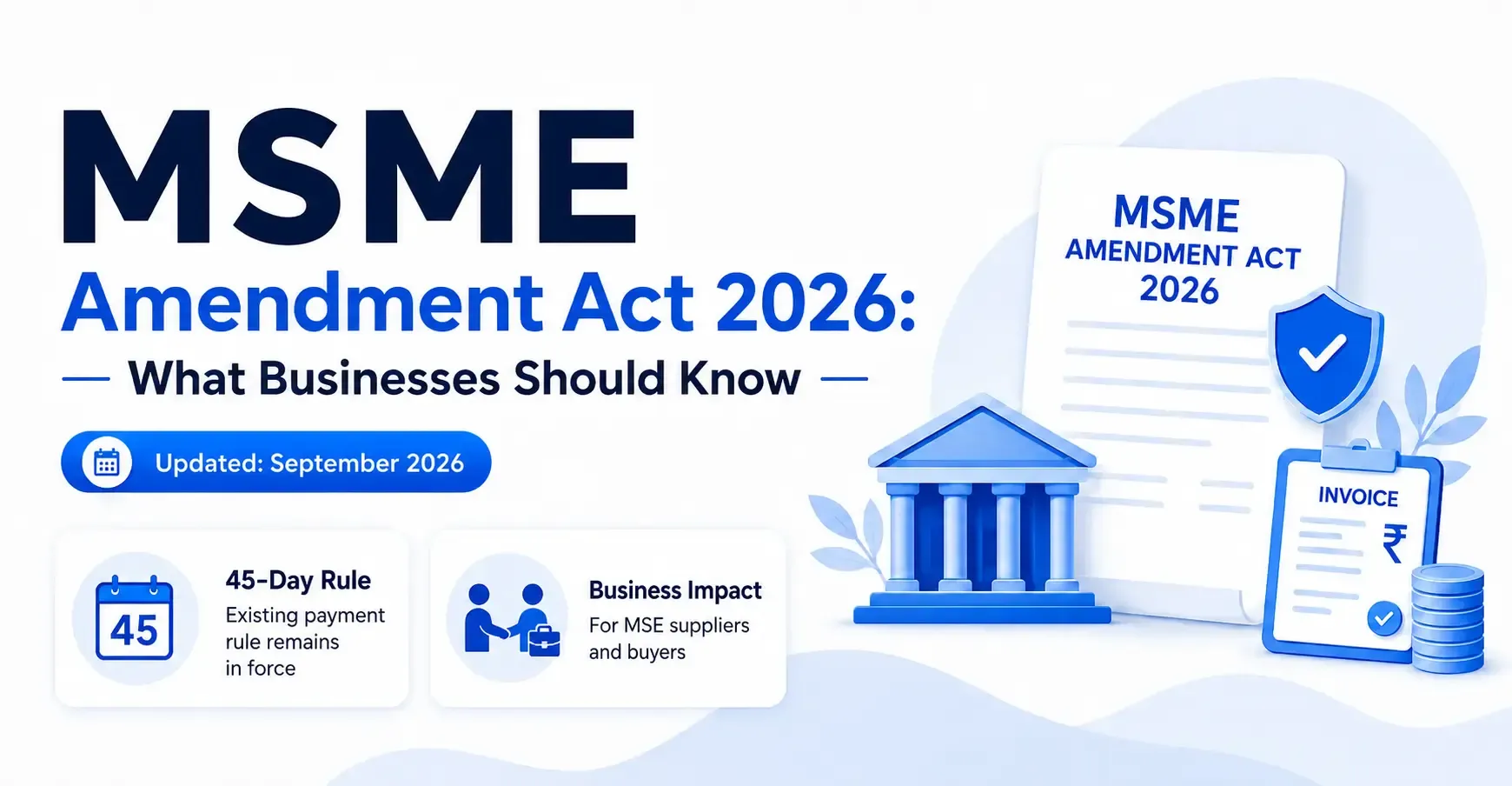
MSME Amendment Act 2026: What Businesses Should Know
- The MSME Amendment Act 2026 introduces faster dispute resolution, stronger payment enforcement and MSME classification changes.
- The MSME Amendment Act 2026 received Presidential assent on 13 August 2026 and came into existence as the amended framework under the MSMED Act 2006.
- The existing maximum 45-day agreed payment period for eligible micro and small suppliers remains in force.
- Specified costs like R&D and pollution control are excluded from MSME investment calculations.
- The Act introduces 90-day dispute timelines, stronger recovery mechanisms, MSME classification changes and MSEFC reforms.
Delayed payments can affect a small supplier’s ability to pay workers, buy materials and accept new orders. According to the Ministry of MSME, the MSME Samadhaan portal had received 2,56,892 applications involving claims of ₹55,244.29 crore as of June 2026. MSE Facilitation Councils had disposed of 58,148 cases.
This article is for micro and small enterprise owners, finance teams, and businesses that purchase from MSME suppliers. It explains the current law, the proposed changes, and what businesses should do next.
Avoid Delays in MSME Payments
Track vendor classification and upcoming payment deadlines to manage MSME dues on time.
What Is the MSME Amendment Act 2026?
The formal name is the Micro, Small and Medium Enterprises Development (Amendment) Act, 2026. It amends the MSMED Act 2006 , which provides the legal framework for the promotion, development and protection of micro, small and medium enterprises .
Its provisions cover enforcement of mediated settlements and arbitral awards, faster mediation and arbitration timelines, changes to MSE Facilitation Councils, MSME classification, graded penalties, digital registration and payment-related measures involving public sector enterprises. Delayed-payment enforcement is its most important business impact.
The current Act already sets payment deadlines, interest consequences and a dispute route. The main weakness has often appeared after a supplier obtains a settlement or award but still faces difficulty recovering the money.
What Is the Current Status of the MSME Amendment Act 2026?
| Legislative Stage | Status |
|---|---|
| Introduced in Rajya Sabha | 28 July 2026 |
| Passed by Rajya Sabha | 3 August 2026 |
| Passed by Lok Sabha | 7 August 2026 |
| Presidential assent | 13 August 2026 |
| Effective date | Depends on commencement notification |
Legislative Stage
Status
Legislative Stage
Status
Legislative Stage
Status
Legislative Stage
Status
Legislative Stage
Status
The MSME Amendment Act 2026 has received Presidential assent. Businesses should check commencement notifications for the operational applicability of individual provisions.
MSMED Act 2006 vs the MSME Amendment Act 2026
The existing Act sets the payment deadline, interest consequences and dispute process.
| Area | Existing Position | Changes Introduced |
|---|---|---|
| Payment deadline | Written payment terms cannot exceed 45 days from acceptance or deemed acceptance | No reported change to the existing limit |
| MSME classification | Classification uses investment and turnover | Specified costs excluded from investment calculation |
| Dispute resolution timelines | MSEFCs handle mediation and arbitration | 90-day mediation and arbitration timelines introduced |
| Interest on delayed payment | Compound interest applies at three times the RBI bank rate | No reported replacement of the existing rule |
| MSE Facilitation Councils | Eligible micro and small suppliers may refer disputes to an MSEFC | States may receive greater flexibility to establish and structure MSEFCs |
| Award challenges | Buyers must satisfy the existing legal conditions to challenge an award | 50% of the award may become payable if the challenge exceeds six months. |
| Recovery of determined amounts | Suppliers may experience delays even after obtaining a settlement or award | Stronger recovery and debt-recognition routes introduced |
Area
Existing Position
Changes Introduced
Area
Existing Position
Changes Introduced
Area
Existing Position
Changes Introduced
Area
Existing Position
Changes Introduced
Area
Existing Position
Changes Introduced
Area
Existing Position
Changes Introduced
Area
Existing Position
Changes Introduced
The MSME Amendment Act 2026 mainly strengthens enforcement after a settlement or award has been issued.
Key Changes Introduced by the MSME Amendment Act 2026
90-Day Timelines for Mediation and Arbitration
The Act introduces fixed timelines for delayed-payment disputes before MSE Facilitation Councils. Mediation must be completed within 90 days from the date fixed for the first appearance. If mediation is unsuccessful, the dispute must be referred to arbitration within 30 days from the date of termination of mediation.
The Act also requires the arbitral award to be made within 90 days from the date of completion of pleadings. It allows for online mediation and arbitration through electronic means, subject to the prescribed mechanism.
These timelines apply from the commencement date notified for the relevant provisions of the MSME Amendment Act 2026.
MSME Classification and Investment Calculation Exclusions
The Act changes the framework for classifying micro, small and medium enterprises. The Central Government may classify enterprises using investment in plant and machinery or equipment and turnover, with the applicable limits to be specified by notification.
Importantly, the Act clarifies that the cost of pollution control, research and development, industrial safety devices and other items specified by notification will be excluded when calculating investment in plant and machinery.
This means these specified costs will not be counted against the applicable investment limit. In practice, this can help eligible enterprises avoid losing their MSME classification because of qualifying investments that are excluded from the calculation. The exact classification limits will depend on the notification issued under the amended framework.
Recovery as Arrears of Land Revenue
The Act provides that an amount due under a mediated settlement agreement or arbitral award may be recovered as arrears of land revenue . Recovery could be handled by the district collector, deputy commissioner or another notified authority where the buyer’s assets are located.
This route applies only after the amount has been determined through a mediated settlement agreement or arbitral award. An unpaid invoice alone cannot be sent directly to a district authority without completing the required dispute resolution process.
Recognition as an Enforceable Debt
An amount determined under a mediated settlement or arbitral award is treated as a valid and legally enforceable debt. It may also be recognized under the Insolvency and Bankruptcy Code, 2016.
This recognition would not automatically begin insolvency proceedings. The supplier would still need to meet the relevant conditions, thresholds and procedures under the IBC.
Relief During Long Award Challenges
Under the existing Act, a buyer generally has to deposit 75% of the awarded amount before a court considers an application to set aside the award.
The Act provides further protection where such a challenge remains pending for more than six months. In that situation, the court may direct the buyer to pay at least 50% of the awarded amount to the supplier.
This would be a court-directed measure. The payment would not become automatic merely because six months had passed.
Changes to MSE Facilitation Councils
The Act gives states greater flexibility to determine the composition of MSE Facilitation Councils and establish additional councils. The Act also introduces defined timelines for mediation and arbitration, which are intended to support faster disposal of delayed-payment disputes.
This could help states manage higher case volumes. However, faster resolution will also depend on timely appointments, administrative support, case management and enforcement.
Graded Penalties and Digital Registration
The Act also introduces graded penalties for certain contraventions, including a warning for a first violation instead of immediately applying conviction-based fines.
It also provides for a national digital platform for free and voluntary filing of MSME registration details. These measures concern registration and compliance and are separate from the delayed-payment recovery provisions.
TReDS Requirements for CPSE Payments
The MSME Amendment Act 2026 requires Central Public Sector Enterprises to settle MSME invoices through RBI-authorised Trade Receivables Discounting System platforms. It also allows states to introduce similar requirements for their public sector enterprises.
For operating CPSEs, however, the requirement is already in force. A separate Ministry of MSME notification dated 30 June 2026 requires them to route the settlement of invoices for goods and services purchased from MSMEs through authorized TReDS platforms. It also introduces disclosure and statutory-audit requirements. The Act strengthens the legal framework around MSME payment settlement through TReDS platforms.
What MSE Suppliers Should Prepare
The enforcement measures introduced by the Act are most useful after a supplier has proved the amount due through mediation or arbitration. A strong claim will still depend on clear records.
Suppliers should also track the date of first appearance and other dispute milestones if a delayed-payment dispute enters the MSEFC process, particularly after the relevant provisions of the Act become operational. They should retain:
- Current Udyam registration details
- Written payment terms and purchase orders
- Invoices and customer ledgers
- Proof of delivery or service completion
- Acceptance records, credit notes and part-payment details
- Records of MSEFC references, mediation dates and settlement or arbitration proceedings
For example, Sharma Electricals supplies goods worth ₹5 lakh on a written 30-day payment term, but the buyer does not make payment after accepting the goods. The MSMED Act governs the payment deadline, applicable interest and dispute resolution process. If Sharma Electricals obtains a mediated settlement or arbitral award but still faces difficulty recovering the amount, the recovery provisions introduced under the MSME Amendment Act 2026 may become relevant.
What Buyers Need to Review
Delayed payments can also affect the buyer’s income-tax deduction. Section 37(2)(g) of the Income-tax Act, 2025 provides that an amount payable to a micro or small enterprise beyond the period allowed under Section 15 of the MSMED Act is deductible on actual payment. This is the current counterpart of Section 43B(h) under the earlier Income-tax Act, 1961.
Buyers should also monitor the supplier's MSME classification under the updated framework after the relevant provisions of the amendment take effect, including the applicable investment and turnover limits. The delayed-payment protection applies to eligible micro and small suppliers, not automatically to every business described as an MSME.
Retail and wholesale traders registered as MSEs only for priority-sector lending benefits do not fall within Section 15 of the MSMED Act, according to a Ministry of MSME clarification dated 28 June 2024. Buyers should therefore check the supplier’s eligible activity and classification rather than relying only on the presence of a Udyam certificate.
BUSY accounting software can help finance teams review vendor aging, invoice dates, due dates and outstanding balances in one place. This can help buyers identify approaching payment deadlines and help suppliers maintain clearer records of unpaid invoices.
Conclusion
The MSME Amendment Act 2026 strengthens delayed-payment protection through faster mediation and arbitration timelines, stronger recovery mechanisms, TReDS-based settlement requirements for CPSE procurement and changes to MSME classification rules. Businesses should track commencement notifications to understand the applicability timeline of individual provisions under the Act.