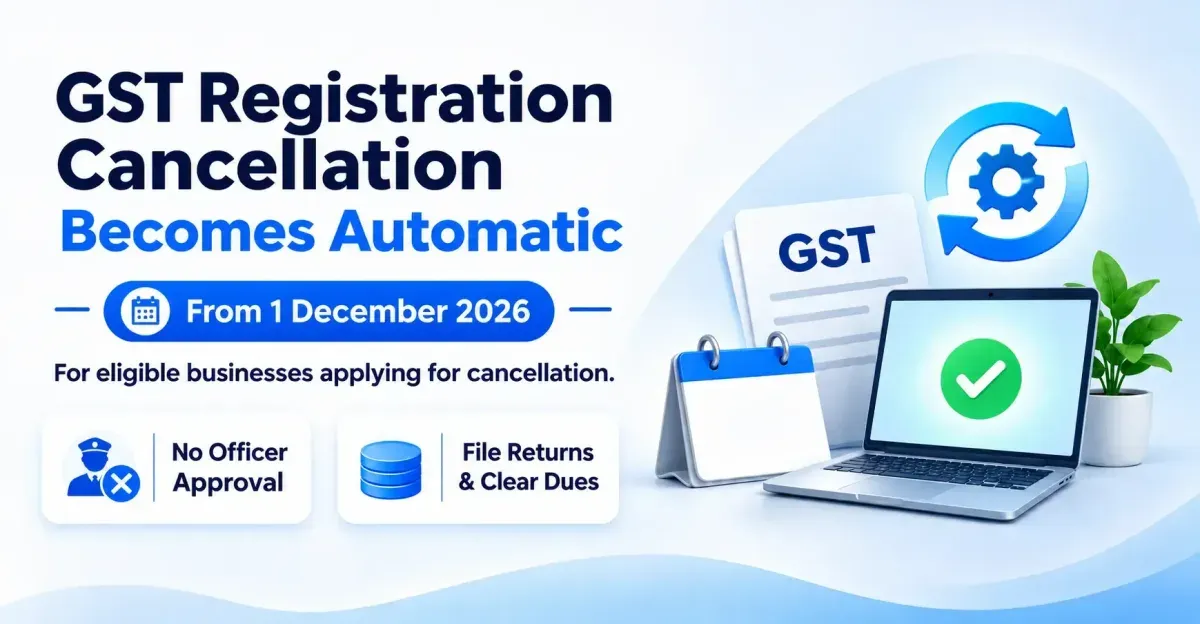
GST Registration Cancellation Becomes Automatic from 1 December 2026
- Eligible businesses can cancel their GST registration without officer approval from 1 December 2026.
- The earlier ₹2.5 lakh monthly GST liability limit on sales to registered buyers no longer applies to automatic cancellation.
- GSTR-10 does not need to be filed early to qualify for automatic cancellation.
- Businesses must still apply through Form GST REG-16, file the required returns and clear outstanding GST dues.
From 1 December 2026, GST registration cancellation becomes easier for businesses that wish to surrender their registration. Under the new rules, the GST portal automatically cancels eligible registrations without requiring approval from a GST officer.
The Central Board of Indirect Taxes and Customs (CBIC) announced this change on 25 November 2026 through Notification No. 08/2026-Central Tax.
Get Your Records Ready for GST Cancellation with BUSY
Review your GST records and remaining stock before applying for registration cancellation.
✓ GST Return Reports
✓ Stock Status Reports
✓ GST Reconciliation
New GST Cancellation Rules from 1 December 2026
Automatic cancellation was first introduced on 1 November 2026 with additional conditions. CBIC has amended Rule 20 of the Central Goods and Services Tax (CGST) Rules, 2017, to remove these conditions. The amendment takes effect on 1 December 2026, making automatic cancellation available to more businesses.
Old vs New GST Cancellation Rules
| Particulars | 1 to 30 November 2026 | From 1 December 2026 |
|---|---|---|
| Monthly output tax condition | GST on sales to registered buyers must not exceed ₹2.5 lakh in any month since registration, unless the GSTR-10 condition is met | Removed |
| Early GSTR-10 filing condition | Alternatively, GSTR-10 must be filed within three days of the due date for filing the remaining returns, where required | Removed |
| Return filing requirements | Mandatory | Mandatory |
| Payment of outstanding GST dues | Mandatory | Mandatory |
| Automatic cancellation | Available under additional conditions | Available to all eligible applicants under Rule 20 |
| Automatic cancellation confirmation | GST REG-38 | GST REG-38 |
Particulars
1 to 30 November 2026
From 1 December 2026
Particulars
1 to 30 November 2026
From 1 December 2026
Particulars
1 to 30 November 2026
From 1 December 2026
Particulars
1 to 30 November 2026
From 1 December 2026
Particulars
1 to 30 November 2026
From 1 December 2026
Particulars
1 to 30 November 2026
From 1 December 2026
Businesses that previously exceeded the monthly tax limit can now qualify for automatic cancellation if their returns and payments are in order.
Eligibility for Automatic GST Registration Cancellation
A taxpayer must meet the following conditions to qualify:
- Submit a cancellation application: File Form GST REG-16 within 30 days of the event requiring cancellation, such as the closure of a business.
- Complete return filing: File all applicable returns due by the application date. If you have already filed GSTR-1 for a tax period, you must also file the corresponding GSTR-3B before applying. File returns for the remaining period by their due dates.
- Clear outstanding dues: Pay any pending GST amounts, along with any interest, late fees or penalties owed.
If you have reported sales through the Invoice Furnishing Facility (IFF), you must also file the corresponding GSTR-3B before applying.
Composition taxpayers must also submit the required CMP-08 statements. In the event of a sole proprietor's death, the 30-day application deadline does not apply. The legal heirs can apply for cancellation.
Once these conditions are met, the GST portal cancels the registration with effect from the date requested in the application.
GST Registration Cancellation Process Under the New Rules
Businesses can continue to apply for cancellation online through the GST portal. Follow these steps:
- Visit the GST portal and log in to your account.
- Go to Services > Registration > Application for Cancellation of Registration.
- Select the reason for cancellation and enter the requested cancellation date.
- Enter details of your remaining stock and any tax payable on it.
- Verify and submit Form GST REG-16 using a Digital Signature Certificate (DSC) or Electronic Verification Code (EVC).
- File the remaining returns by their due dates and clear any outstanding dues.
- Download Form GST REG-38, which is the confirmation issued by the GST portal when it cancels your registration automatically. Check the effective cancellation date shown in the form.
Your GST registration remains suspended while the cancellation application is being processed. If a GST officer approves the cancellation instead, you receive a cancellation order in Form GST REG-19. Use your Application Reference Number (ARN) to track the application on the GST portal.
Changes to Form GST REG-16
From 1 December 2026, under Notification No. 05/2026-Central Tax, the cancellation application form includes revised fields for reporting stock and the amount of input tax credit (ITC) to be reversed. The revised form also allows businesses to indicate whether they want to file a NIL return for the remaining tax period, if eligible.
When Is Officer Approval Required?
After you apply, the portal forwards the application to a GST officer if returns for the remaining period are not filed as required or any payable amounts remain unpaid. The following timelines apply under Rule 20:
| Action | Time Limit |
|---|---|
| Officer approves the application or issues a notice in REG-03 | Within 15 days of receiving the application from the GST portal |
| Taxpayer replies through REG-04 | Within 15 days of receiving the notice |
| Officer approves or rejects the application after receiving the reply | Within 15 days of receiving the reply |
Action
Time Limit
Action
Time Limit
Action
Time Limit
If the taxpayer fails to respond within the prescribed period, the application is treated as rejected. If the officer fails to act within the applicable time limit, the application is treated as approved.
GST Cancellation by Officers: Two Grounds Restored
In a separate correction issued on 25 November 2026, CBIC restored two grounds for cancellation by GST officers under Rule 21 of the CGST Rules:
- The taxpayer does not conduct business from the declared place of business.
- The taxpayer issues invoices without actually supplying goods or services.
These grounds relate to cancellation initiated by the GST department and are separate from the automatic cancellation facility available to taxpayers on their own request.
GST Payable on Remaining Stock
Input tax credit (ITC) is the credit claimed for GST paid on business purchases. If goods remain in stock when you cancel your registration, you may need to pay back an amount linked to that credit.
Under Section 29(5) of the CGST Act, businesses must pay either the input tax credit claimed on the remaining stock or the GST payable on that stock, whichever is higher. Different calculation rules apply to capital goods, such as machinery. This requirement remains unchanged under the new cancellation rules.
For example: A trader closing his business has claimed ₹72,000 in input tax credit on unsold stock. The GST payable on the same stock is ₹66,000. In this case, the trader must pay ₹72,000.
GSTR-10 Filing After GST Cancellation
Regular GST taxpayers must file Form GSTR-10 as their final return after cancellation. It must be filed within three months of the cancellation date or the date of the cancellation order, whichever is later.
Filing GSTR-10 before cancellation is no longer a condition for automatic approval. The final-return requirement still applies to regular taxpayers. Composition taxpayers do not need to file GSTR-10.
Preparing for GST Registration Cancellation
Before surrendering your GSTIN, compare your accounting records with the returns filed on the GST portal. Check whether any tax payments are pending and verify the value of your remaining stock. Keep your invoices and accounting records even after cancellation, as the GST department may examine tax liabilities relating to earlier periods.
BUSY accounting software helps you identify differences between your books and GST portal data through GST reconciliation reports. Its Stock Summary and stock valuation reports provide details of the goods remaining in your inventory.
Conclusion
The new rules make it easier for businesses to exit GST registration without unnecessary delays. After submitting your cancellation application, track its status on the GST portal until you receive confirmation. Check the effective cancellation date and complete any remaining return filing requirements.